9 Best Automated Helpdesk Solutions for B2B Teams in 2026
Discover the best automated helpdesk solutions for B2B SaaS teams in 2026, evaluated across automation depth, AI resolution quality, live agent handoff, analytics, and integrations. This guide compares nine leading platforms—from legacy tools with AI add-ons to purpose-built autonomous agents—helping support leaders choose the right solution to resolve tickets intelligently at scale without overwhelming their team.
 Grant CooperFounder13 min read
Managing customer support at scale without burning out your team is one of the defining challenges for B2B SaaS companies today. The right automated helpdesk solution doesn't just deflect tickets: it resolves them intelligently, surfaces business insights, and hands off seamlessly to humans when it matters.
The market has matured significantly. The dominant shift heading into 2026 is from rule-based chatbots and macro-driven automation toward genuinely autonomous AI agents capable of resolving tickets end-to-end. Legacy platforms have bolted AI layers onto existing architectures. A new class of AI-first tools has built resolution as the primary goal from day one.
This list evaluates the top automated helpdesk solutions on five criteria: automation depth, ticket resolution quality, live agent handoff, analytics, and integration ecosystem. Whether you're running a lean support team on Zendesk, evaluating Intercom alternatives, or looking to go fully AI-first, there's a fit here for your stage and stack.
1. Halo AI
Best for: B2B SaaS teams that want AI-first autonomous support with business intelligence built in.
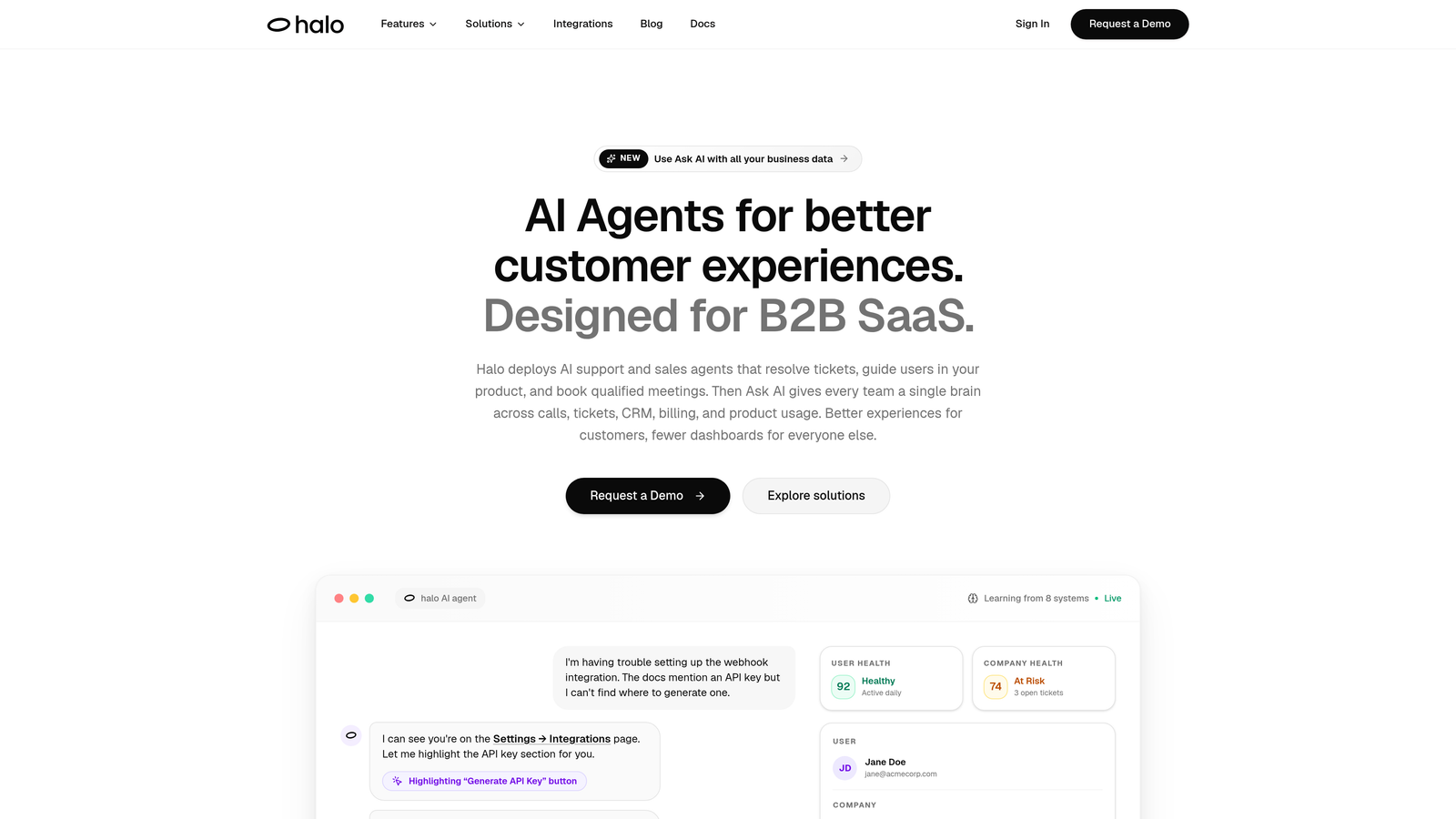
Halo AI is an AI-first customer support platform that deploys autonomous agents to resolve tickets, guide users through your product with page-aware context, and surface business intelligence signals — all while learning from every interaction.
Where This Tool Shines
What separates Halo from most tools on this list is its architecture. It wasn't built by adding an AI layer to an existing helpdesk: the entire platform is designed around autonomous resolution as the primary outcome. That distinction matters when you're evaluating whether AI will genuinely deflect tickets or simply assist agents in doing the same work faster.
The page-aware chat widget is a standout capability. The AI sees what the user sees in your product, enabling contextual visual guidance rather than generic FAQ responses. Combine that with a smart inbox that surfaces customer health signals, revenue anomalies, and churn indicators, and you have a support platform that functions as a business intelligence layer, not just a cost center.
Key Features
Autonomous AI Agents: Resolve tickets end-to-end without human intervention, improving with every interaction through continuous learning.
Page-Aware Chat Widget: The AI sees the user's current product context and delivers visual UI guidance specific to where they are in your product.
Smart Inbox with Business Intelligence: Surfaces customer health signals, revenue anomalies, and churn indicators alongside ticket data — not just support metrics.
Auto Bug Ticket Creation: Automatically creates and routes bug reports directly to Linear, closing the loop between support and engineering.
Live Agent Handoff: Escalates to human agents with full conversation context preserved, so nothing is lost in the transfer.
Integration Ecosystem: Connects to Linear, Slack, HubSpot, Intercom, Stripe, Zoom, PandaDoc, and Fathom for a complete business stack view.
Best For
B2B SaaS product teams that want to move beyond ticket management and treat support as a source of business intelligence. Particularly well-suited for teams building on top of existing tools like Intercom or HubSpot who want AI-first resolution without replacing their entire stack.
Pricing
Contact for pricing. A demo is available at haloagents.ai. Pricing is tailored to team size and use case.
2. Zendesk
Best for: Enterprise teams with complex routing, SLA requirements, and existing Zendesk investments.
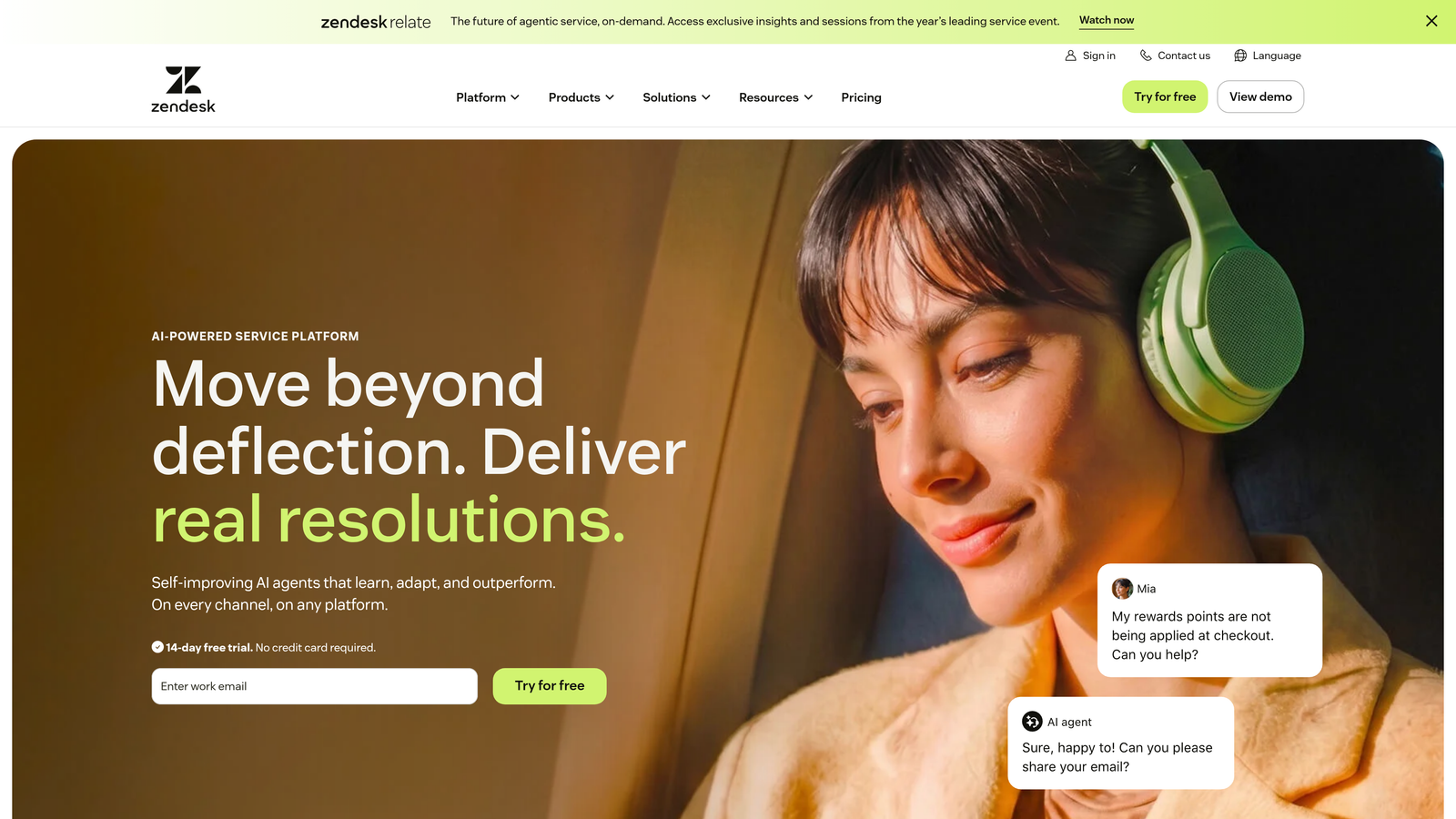
Zendesk is the industry-standard enterprise helpdesk with a broad omnichannel feature set and an AI Copilot layer added to its core ticketing and routing engine.
Where This Tool Shines
Zendesk's strength is its maturity. Hundreds of integrations, deeply configurable workflows, and robust SLA management make it the default choice for enterprise support teams with complex operational requirements. If your team has built years of process on Zendesk, the switching cost is real.
The AI Copilot layer adds intelligent triage, suggested responses, and agent assistance to the core platform. It's worth noting that these AI features are additions to an existing ticket-based architecture rather than a ground-up AI design, which means the experience is more "AI-assisted agent" than "autonomous resolution."
Key Features
AI Copilot: Provides agent assistance, intelligent triage, and suggested responses layered onto the core ticketing engine.
Omnichannel Support: Covers email, chat, voice, social, and messaging from a unified platform.
Advanced Routing and SLA Management: Highly configurable workflow automation for complex enterprise support operations.
App Marketplace: Hundreds of third-party integrations covering virtually every business tool category.
Reporting and Analytics: Robust dashboards for team performance, SLA compliance, and ticket volume trends.
Best For
Enterprise teams with existing Zendesk investments, complex multi-tier routing requirements, or strict SLA compliance needs. Less ideal for teams starting fresh and prioritizing autonomous AI resolution over agent-assisted workflows.
Pricing
Suite Team starts at approximately $55/agent/month. Enterprise tiers scale considerably higher. Check zendesk.com for current pricing, as enterprise add-ons can significantly affect total cost.
3. Intercom
Best for: PLG SaaS teams that want conversational support, product engagement, and AI resolution in one platform.
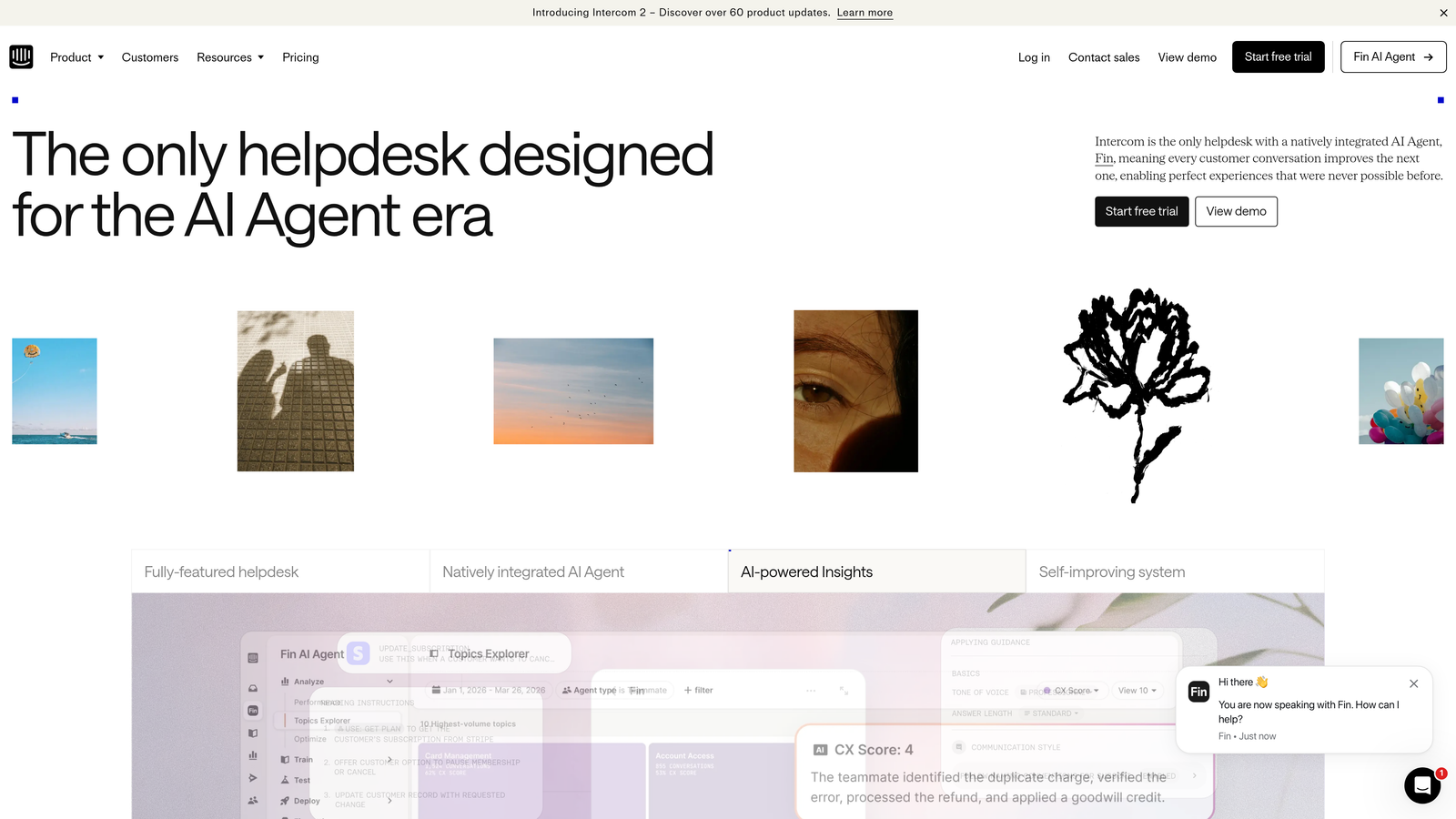
Intercom is a conversational support platform combining the Fin AI agent, in-app messaging, and product engagement tools in a single platform built for SaaS teams.
Where This Tool Shines
Fin, Intercom's LLM-based AI agent, is one of the more capable autonomous resolution tools available in an established platform. It draws on your help content and product context to resolve queries without agent involvement. For SaaS teams with a product-led growth motion, the combination of support, onboarding flows, and outbound messaging in one platform reduces tool sprawl significantly.
It's worth noting that Halo AI lists Intercom as an integration partner, meaning teams can layer Halo's business intelligence and page-aware capabilities alongside existing Intercom workflows rather than replacing them outright.
Key Features
Fin AI Agent: LLM-based autonomous resolution that draws on your knowledge base and product context to answer queries end-to-end.
In-App Messaging: Full customer lifecycle context available to both AI and human agents during support interactions.
Product Tours and Onboarding Flows: Combines support with user activation in a single platform.
Unified Inbox: Inbox, help center, and outbound messaging managed from one workspace.
Usage-Based Fin Pricing: Fin AI is charged per resolution, which aligns cost with actual automation value delivered.
Best For
SaaS companies with product-led growth models that want support, onboarding, and AI resolution in one place. Can become expensive for teams using it purely for support without leveraging the broader product engagement features.
Pricing
Starts at approximately $39/seat/month. Fin AI resolutions are charged separately on a usage basis. Visit intercom.com for current pricing details.
4. Freshdesk
Best for: Growing B2B support teams that need solid omnichannel automation at competitive pricing.
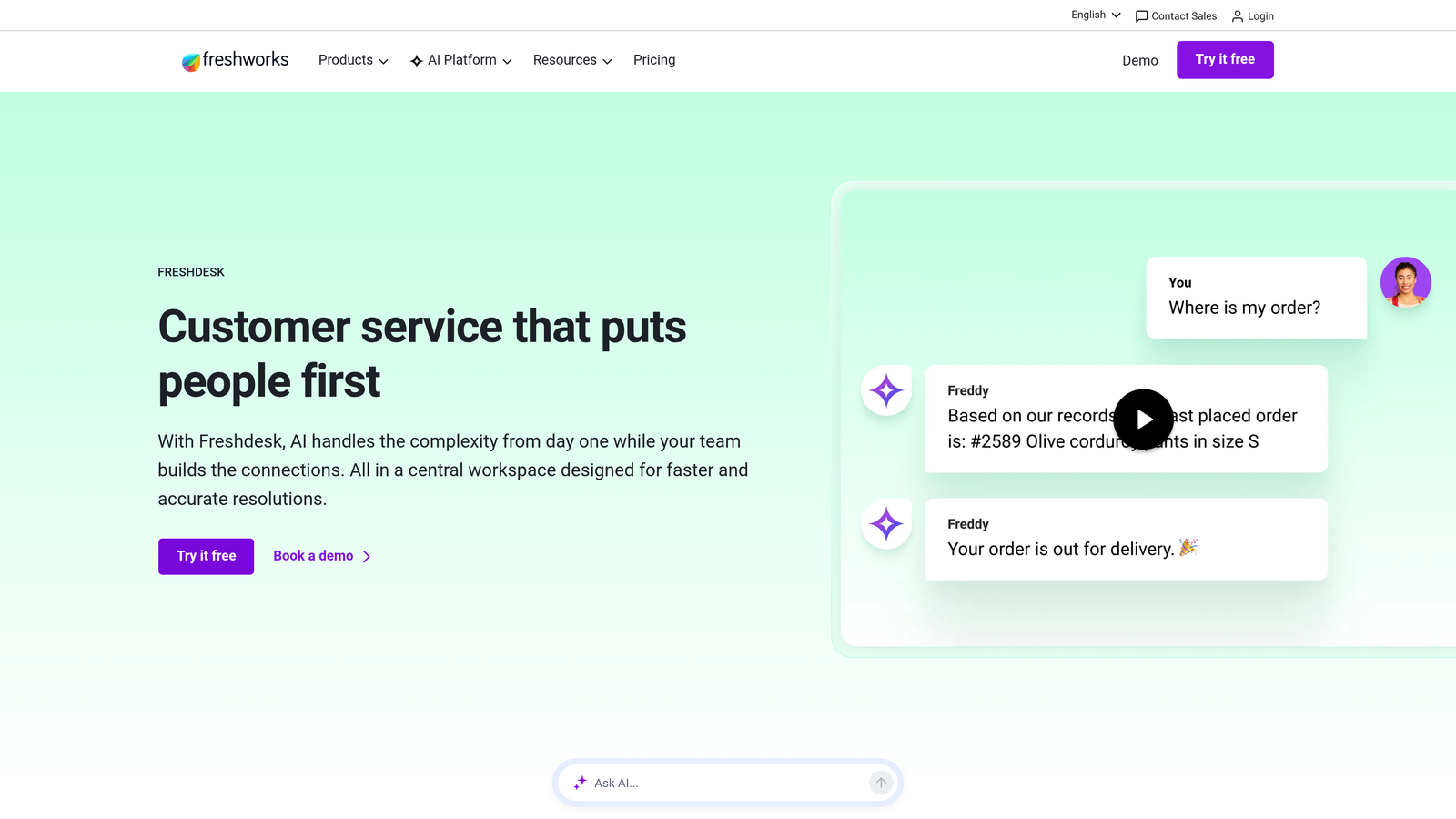
Freshdesk is a well-rounded omnichannel helpdesk with Freddy AI for automation, competitive pricing, and a strong free tier that makes it a popular choice for teams scaling their support operations.
Where This Tool Shines
Freshdesk hits a strong value-to-capability ratio. Freddy AI handles automated responses, ticket summarization, and agent suggestions across a solid omnichannel foundation. For teams transitioning from purely manual support to their first layer of automation, the learning curve is manageable and the free tier provides a genuine starting point.
The AI capabilities are more assistive than fully autonomous compared to AI-first platforms, but for many SMB and mid-market B2B teams, that's exactly the right balance. You get automation without needing to fully trust an AI agent to resolve tickets independently from day one.
Key Features
Freddy AI: Handles automated responses, ticket summarization, and suggested replies for agent productivity.
Omnichannel Ticketing: Covers email, chat, phone, and social from a unified inbox.
Collision Detection: Prevents multiple agents from working the same ticket simultaneously.
Workflow Automation: Scenario automations and SLA policies for streamlined ticket routing and escalation.
Free Tier: A functional free plan for small teams getting started with helpdesk software.
Best For
SMB and mid-market B2B teams that need a reliable omnichannel helpdesk with AI assistance at an accessible price point. Particularly well-suited for teams making their first move from email-based support to a structured helpdesk platform.
Pricing
Free tier available. Growth plan starts at approximately $15/agent/month. Visit freshworks.com/freshdesk for current plan details.
5. Help Scout
Best for: Teams that prioritize a warm, human-feeling support experience with AI as a productivity assist rather than autonomous replacement.
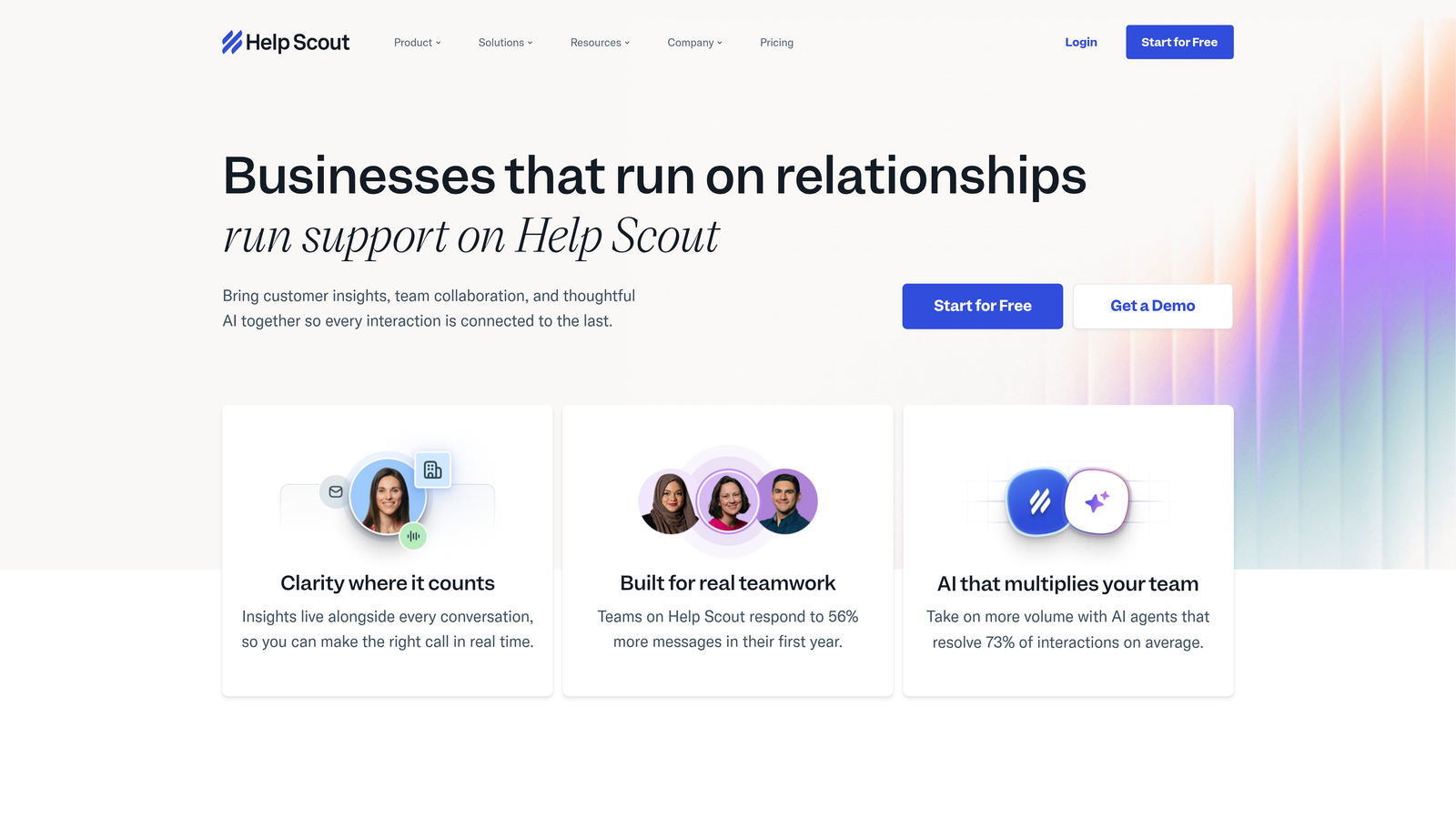
Help Scout is a human-centered support platform that layers AI assistance onto a shared inbox model designed to feel like email, not a ticket queue.
Where This Tool Shines
Help Scout is built on a deliberate philosophy: support should feel human. There are no ticket numbers in the customer-facing experience, and the interface is designed to preserve a conversational tone. The AI Summarize and AI Assist features boost agent productivity without removing the human from the resolution loop.
For brands where voice and warmth are core to the customer experience, this is a meaningful differentiator. The Beacon widget handles in-app self-service and contextual help without breaking that conversational feel. If your brand's support identity is a strength you want to preserve, Help Scout is built around that priority.
Key Features
AI Summarize and AI Assist: Helps agents summarize long threads and draft replies faster without autonomous resolution.
No-Ticket-Number Inbox: Shared inbox experience that preserves a conversational, email-like feel for customers.
Beacon Widget: In-app widget for contextual self-service, knowledge base access, and live chat.
Docs Knowledge Base: Built-in knowledge base with AI-assisted article suggestions for self-service deflection.
Team Performance Reporting: Clean dashboards focused on response times, CSAT, and team productivity.
Best For
Teams with a brand voice that values warmth and human connection in support interactions. Less suited for teams whose primary goal is maximum autonomous resolution and AI deflection at scale.
Pricing
Starts at approximately $22/user/month. Visit helpscout.com for current plan details.
6. Zoho Desk
Best for: Teams already in the Zoho ecosystem that want AI-assisted support tightly connected to CRM and analytics.
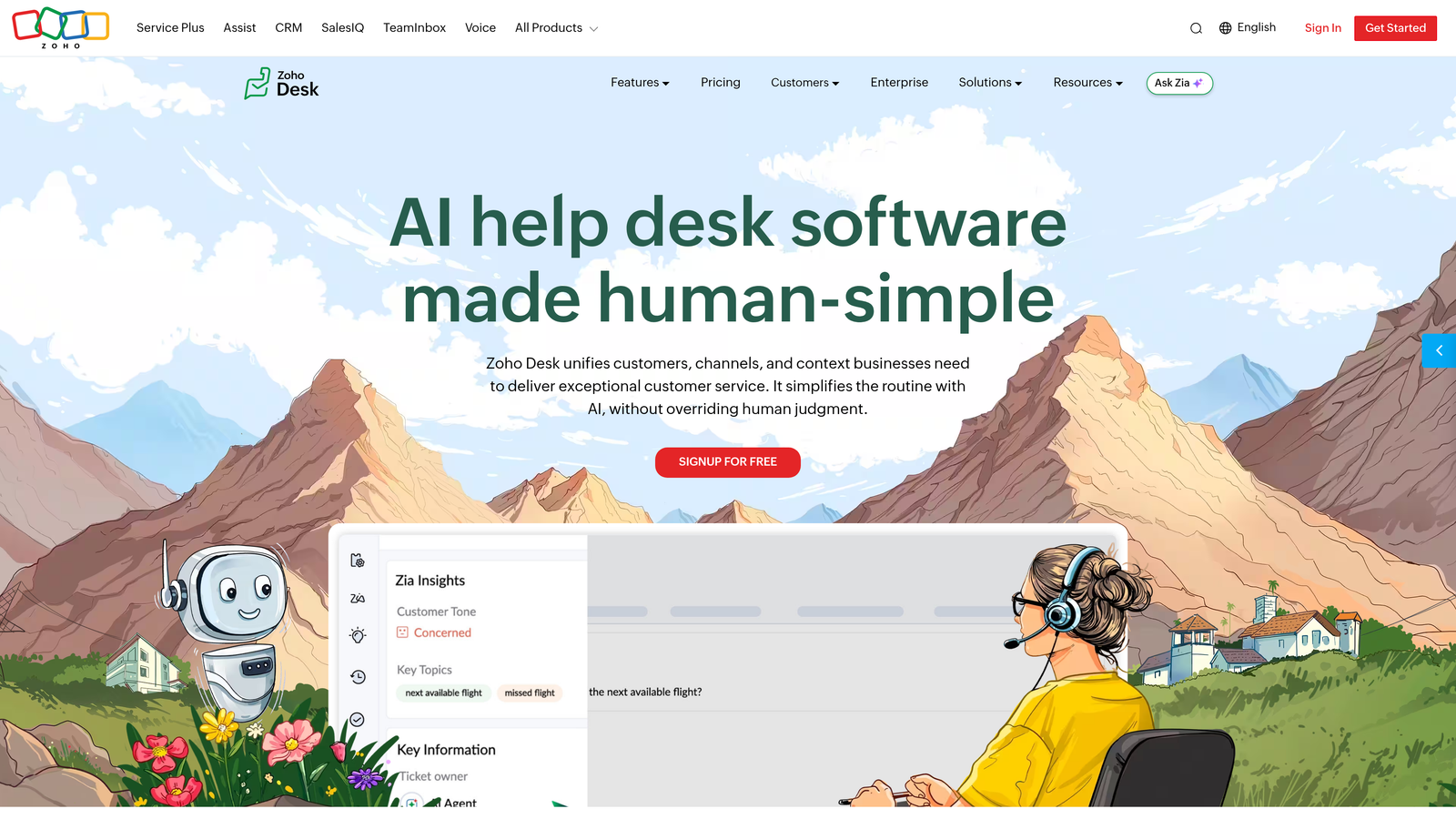
Zoho Desk is a context-aware helpdesk with Zia AI for sentiment analysis and anomaly detection, tightly integrated with the broader Zoho business suite.
Where This Tool Shines
Zoho Desk's strongest argument is ecosystem depth. If your team already uses Zoho CRM, Zoho Analytics, or other Zoho products, the native integrations create a level of cross-departmental visibility that third-party integrations rarely match. Zia AI adds genuine analytical value: sentiment analysis, anomaly detection, and auto-tagging help teams spot issues before they escalate.
The Blueprint workflow automation is also worth highlighting for teams with complex, multi-step support processes. It's more sophisticated than basic SLA rules, enabling conditional logic across departments and approval chains that enterprise support often requires.
Key Features
Zia AI: Provides sentiment analysis, auto-tagging, anomaly detection, and response suggestions for agent and manager visibility.
Blueprint Workflow Automation: Configures complex, multi-step support processes with conditional logic and cross-departmental routing.
Zoho Ecosystem Integration: Deep native connections to Zoho CRM, Zoho Analytics, and 40+ other Zoho applications.
Omnichannel Coverage: Handles email, chat, phone, social, and web forms from a unified platform.
Customizable Dashboards: Cross-departmental visibility with reporting that extends beyond support metrics.
Best For
Teams already operating within the Zoho product suite who want support, CRM, and analytics in a tightly connected environment. The value proposition weakens significantly for teams not already using Zoho products.
Pricing
Free tier available. Standard plan starts at approximately $14/agent/month. Visit zoho.com/desk for current pricing.
7. Tidio
Best for: Startups and small teams that need conversational AI support running quickly with minimal setup.
Tidio is a fast-to-deploy AI support platform featuring the Lyro AI agent, built for teams that need automation live quickly without heavy IT involvement.
Where This Tool Shines
Tidio's headline advantage is time-to-value. The Lyro AI agent can be live within hours rather than weeks, which is a genuine differentiator for small teams that can't afford a lengthy implementation project. The visual chatbot flow builder lets non-technical team members build custom automation paths without developer support.
It's a straightforward platform without the enterprise complexity of Zendesk or the PLG toolset of Intercom. For startups that need conversational automation running immediately, that simplicity is a feature, not a limitation.
Key Features
Lyro AI Agent: Handles autonomous conversational support resolution across live chat and messaging channels.
Fast Deployment: Can be live within hours, making it one of the quickest paths from signup to active automation.
Unified Inbox: Live chat, email, and Messenger support managed from a single workspace.
Visual Chatbot Builder: Drag-and-drop flow builder for custom automation paths without coding.
Affordable Entry Pricing: Accessible free tier with paid plans that scale gradually as usage grows.
Best For
Startups, small B2B teams, and businesses that need immediate conversational automation without complex enterprise requirements. Less suited for teams with intricate multi-step workflows, deep CRM integration needs, or high-volume enterprise support operations.
Pricing
Free tier available. Lyro AI plans start at approximately $29/month. Visit tidio.com for current pricing details.
8. Kustomer
Best for: High-volume support teams that need a unified customer timeline and CRM-native context across every interaction.
Kustomer is a CRM-native helpdesk that centers every interaction around a unified customer timeline, with AI-powered workflows designed for relationship-intensive support at scale.
Where This Tool Shines
Kustomer's core differentiator is the customer timeline view. Rather than organizing work around individual tickets, every agent interaction is anchored to a complete history of the customer across all channels. For support teams handling complex, multi-touch relationships, this context significantly changes what an agent can do in a single conversation.
It's worth noting that Kustomer is now part of the Meta ecosystem following its acquisition, which introduces both scale and some strategic uncertainty for buyers evaluating long-term platform risk. AI-powered intent detection and routing are solid, though the platform skews toward enterprise pricing.
Key Features
Unified Customer Timeline: Full interaction history across all channels presented in a single chronological view for every agent.
AI-Powered Intent Detection: Automatically classifies and routes incoming conversations based on detected customer intent.
Omnichannel Coverage: Handles email, chat, voice, SMS, social, and WhatsApp from one platform.
Proactive Outreach Workflows: Automated follow-up and outbound workflows for proactive customer engagement.
Deep CRM Data Integration: Customer data from CRM systems surfaces in context during every support interaction.
Best For
Enterprise and mid-market teams with high interaction volumes and complex customer relationships that require rich historical context. The pricing tier makes it less accessible for smaller teams.
Pricing
Enterprise pricing, typically starting at approximately $89/user/month. Visit kustomer.com for current pricing and packaging.
9. Gorgias
Best for: B2B teams managing both product support and transactional queries with deep e-commerce platform integrations.
Gorgias is a revenue-focused helpdesk with deep e-commerce integrations and AI autoclose capabilities, suited for teams that handle product support alongside order and transaction-related queries.
Where This Tool Shines
Gorgias is built with e-commerce DNA, and that focus shows in its most distinctive feature: revenue-attributed support metrics. Rather than tracking only ticket volume and response times, Gorgias links support interactions to customer lifetime value and order data. For B2B teams that also manage transactional support, this creates a direct line of sight between support activity and revenue impact.
The AI autoclose feature handles repetitive, low-complexity tickets like order status and shipping queries without agent involvement. For businesses with high volumes of predictable transactional queries, this can meaningfully reduce manual workload. Teams without e-commerce workflows will find less to differentiate Gorgias from other options on this list.
Key Features
AI Autoclose: Automatically resolves and closes repetitive low-complexity tickets such as order status, shipping updates, and FAQ queries.
E-Commerce Integrations: Deep native connections to Shopify, WooCommerce, and BigCommerce for transactional context in every ticket.
Revenue-Attributed Metrics: Links support ticket data to customer LTV and order history to measure revenue impact of support activity.
Macros and Rules Engine: High-volume ticket automation through templated responses and conditional routing rules.
Omnichannel Inbox: Manages email, chat, social, SMS, and voice from a single unified workspace.
Best For
B2B companies that manage both product support and transactional or order-related queries, particularly those operating on Shopify or similar e-commerce platforms. Less suited for pure SaaS B2B teams without a transactional support component.
Pricing
Starts at approximately $10/month, scaling based on ticket volume. Visit gorgias.com for current pricing tiers.
Which Tool Is Right for Your Team?
The right automated helpdesk depends on where you are in your support maturity and what you're optimizing for. Here's a quick guide to cut through the options.
AI-first SaaS teams: Halo AI is the strongest choice for teams that want autonomous resolution, page-aware context, and business intelligence built into their support layer from day one. It's built for resolution, not ticket management.
Enterprise teams with existing Zendesk investments: Zendesk with AI Copilot gives you AI assistance without abandoning years of configured workflows and integrations. The trade-off is that AI remains assistive rather than autonomous.
PLG SaaS companies: Intercom's combination of Fin AI, product tours, and lifecycle messaging makes it the natural fit for product-led growth motions where support and activation overlap.
Budget-conscious SMBs: Freshdesk's free tier and affordable Growth plan offer a solid foundation. Tidio is the better choice if speed of deployment matters more than feature depth.
Zoho ecosystem teams: Zoho Desk delivers the strongest value for teams already running on Zoho CRM and Analytics. Outside that ecosystem, the advantage diminishes quickly.
Human-first support cultures: Help Scout is the right fit for teams where brand voice and conversational warmth are non-negotiable, and AI is a productivity assist rather than an autonomous agent.
For most B2B SaaS teams evaluating this space seriously in 2026, the central question is whether you want AI that assists your agents or AI that resolves tickets independently. That distinction narrows the field quickly.
Your support team shouldn't scale linearly with your customer base. Let AI agents handle routine tickets, guide users through your product, and surface business intelligence while your team focuses on complex issues that need a human touch. See Halo in action and discover how continuous learning transforms every interaction into smarter, faster support.