9 Best AI Helpdesk Solutions for Product Teams in 2026
This guide reviews the 9 best AI helpdesk solution for product teams in 2026, covering platforms that go beyond ticket deflection to integrate with developer tools, automate resolution, and transform customer support interactions into actionable product intelligence. Whether you're a growing startup or an established SaaS team, it helps you find the right fit for a product-led workflow.
 Grant CooperFounder13 min read
Product teams occupy a unique position in the support ecosystem. They need to resolve tickets fast, but they also need every support interaction to feed back into the product itself. A bug report sitting in a queue is a missed signal. A feature request buried in a thread is a lost roadmap insight.
The right AI helpdesk solution doesn't just deflect tickets. It connects support to your engineering workflow, surfaces product intelligence, and scales without adding headcount. But not every tool is built with product teams in mind. Many are designed for traditional support centers, not teams that live in Linear, Slack, and GitHub.
This list focuses on AI helpdesk tools that genuinely serve product-led organizations: platforms that automate resolution, integrate with developer tools, and turn customer conversations into actionable product signals. Whether you're a startup scaling past your first 100 customers or an established SaaS team drowning in tickets, one of these solutions should fit your workflow.
1. Halo AI
Best for: B2B SaaS and product teams that need AI-first support with deep developer tool integration
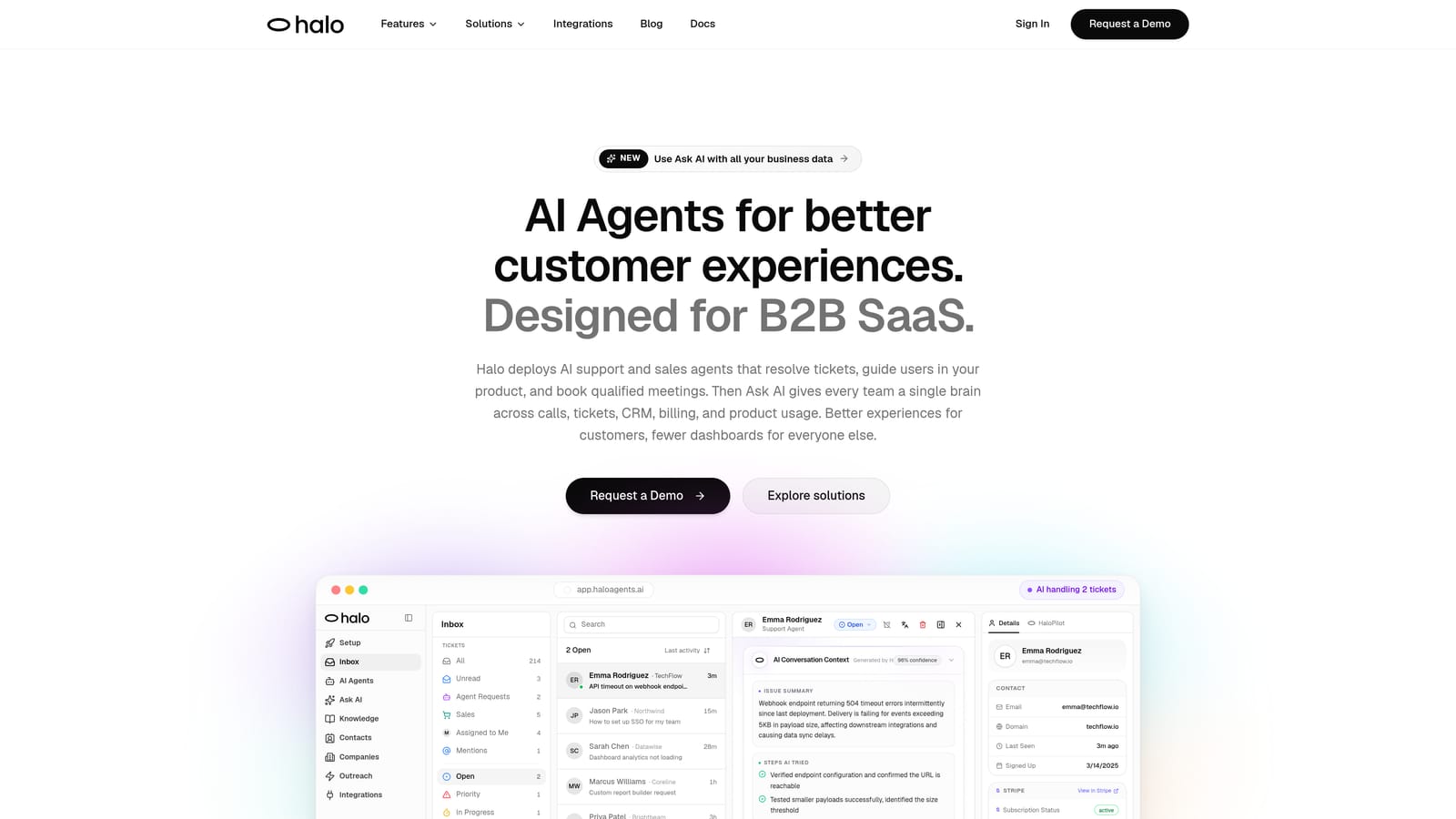
Halo AI is an AI-first customer support platform built from the ground up for product-led B2B SaaS teams.
Where This Tool Shines
Halo AI's most distinctive capability is its page-aware context. The chat widget doesn't just know who the user is — it understands where they are in your product at that moment. That context shapes every AI response, making guidance more relevant and resolution faster without requiring users to explain their situation from scratch.
What separates Halo from retrofitted AI layers on legacy helpdesks is its product-to-engineering pipeline. When a user reports a bug, Halo can automatically create a structured ticket in Linear, routing the issue directly to engineering without anyone manually copying information between systems. Combined with a smart inbox that surfaces customer health signals, revenue anomalies, and churn indicators, Halo turns your support queue into a continuous stream of product intelligence.
Key Features
Page-Aware Chat Widget: Understands the user's current location in your product, enabling contextually accurate AI responses without requiring users to describe their environment.
Autonomous AI Agents: Resolve tickets end-to-end without human intervention, learning from every interaction to improve over time.
Auto Bug Ticket Creation: Automatically generates structured bug reports and routes them directly to Linear, closing the loop between support and engineering.
Smart Inbox with Business Intelligence: Surfaces customer health signals, revenue anomalies, and churn indicators alongside standard support metrics.
Live Agent Handoff: Escalates complex issues to human agents with full context preserved, so agents never start from zero.
Native Integrations: Connects with Slack, HubSpot, Intercom, Stripe, Zoom, PandaDoc, and Fathom for a complete business stack view.
Best For
Product teams at B2B SaaS companies who want AI-first architecture rather than AI bolted onto a legacy helpdesk. Particularly well-suited for teams using Linear for engineering workflows and those who need support signals to feed directly into product decisions.
Pricing
Contact for pricing. A demo is available at haloagents.ai to see the platform in action before committing.
2. Intercom
Best for: Teams that want conversational in-app support with a mature AI agent layer
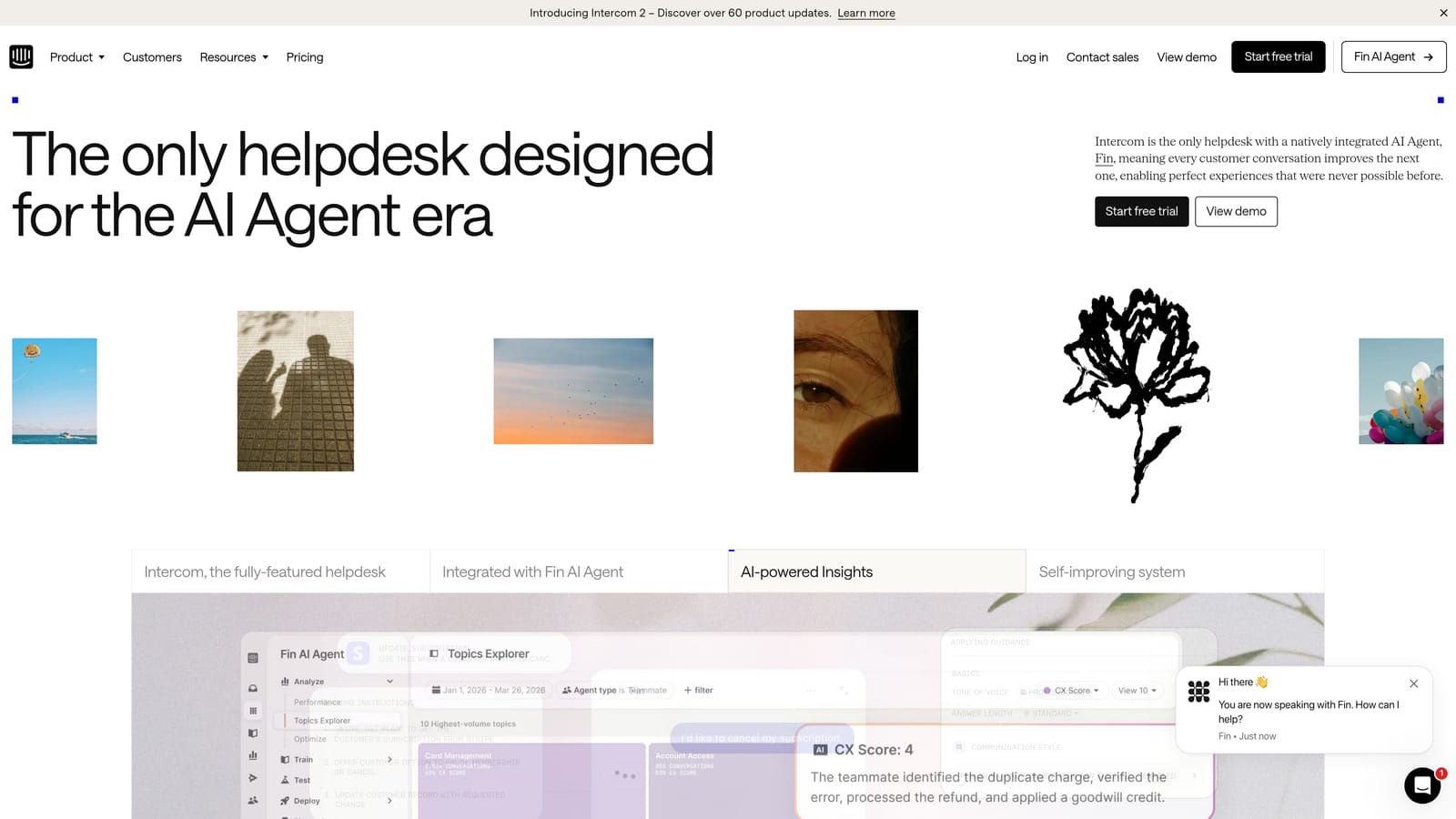
Intercom is an established conversational support platform with the Fin AI agent at its core and deep in-app messaging capabilities.
Where This Tool Shines
Intercom has been a staple for SaaS support teams for years, and Fin AI represents their most significant push into autonomous resolution. Fin can handle a wide range of customer queries without agent involvement, drawing on your knowledge base and product documentation to generate accurate responses.
Intercom's in-app messenger and product tour capabilities make it a natural fit for teams that want support and onboarding to live in the same platform. Its workflow automation handles ticket routing and escalation cleanly, and the app marketplace offers broad integration coverage for teams with complex existing stacks.
Key Features
Fin AI Agent: Handles autonomous customer query resolution using your existing knowledge base content.
In-App Messenger: Delivers support and product tours natively inside your product experience.
Workflow Automation: Routes and escalates tickets based on configurable logic without manual triage.
Conversation Analytics: Tracks resolution rates, response times, and conversation trends across your support operation.
App Marketplace: Extensive integrations across CRM, billing, and developer tools.
Best For
Teams already invested in the Intercom ecosystem or those who want a single platform for support, onboarding, and in-app messaging. Note that Halo AI offers a native Intercom integration, so teams can use both in tandem if needed.
Pricing
Starts at approximately $39/seat/month; AI features are available on higher tiers. Check intercom.com for current pricing.
3. Zendesk AI
Best for: Enterprise teams that need a proven, deeply configurable helpdesk with AI layered across the stack
Zendesk AI is an enterprise-grade helpdesk platform with AI capabilities spanning triage, routing, agent assistance, and self-service.

Where This Tool Shines
Zendesk's strength is breadth. Its AI features cover intelligent triage, automated routing, AI-generated reply suggestions, and self-service deflection — all backed by one of the most mature reporting suites in the industry. For enterprise teams with complex support operations, that depth is hard to match.
The marketplace of over 1,000 integrations means Zendesk can connect to almost any tool in your stack. The tradeoff is that the platform can feel heavyweight for smaller product teams, and AI features are largely add-ons to the core platform rather than the architectural foundation.
Key Features
Intelligent Triage: AI-powered ticket classification and routing based on intent, sentiment, and content.
AI Reply Suggestions: Generates agent response drafts to reduce handling time on common queries.
Advanced Analytics: Deep reporting suite covering agent performance, ticket trends, and customer satisfaction.
1,000+ Marketplace Integrations: Connects with virtually any tool in a modern SaaS stack.
Enterprise Security: Compliance controls and security features designed for regulated industries and large organizations.
Best For
Larger SaaS companies or enterprises with established support operations, significant ticket volumes, and complex compliance or security requirements. Less ideal for early-stage product teams looking for a lean, AI-native experience.
Pricing
Suite plans start around $55/agent/month; AI add-ons carry additional cost. Check zendesk.com for current pricing.
4. Freshdesk (Freddy AI)
Best for: Budget-conscious product teams that want AI-assisted support across multiple channels
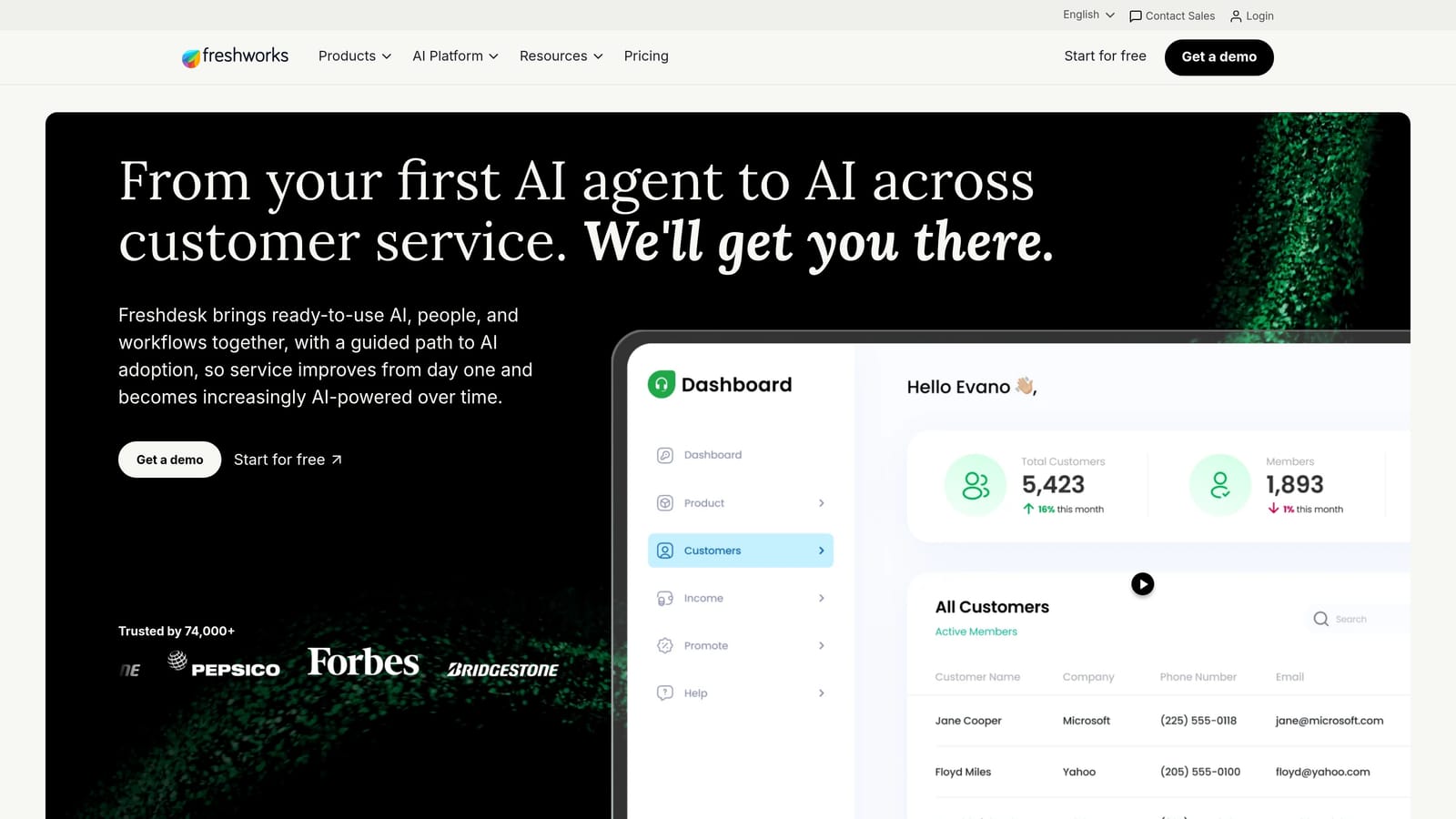
Freshdesk is a full-featured helpdesk platform with Freddy AI built across self-service, agent assistance, and analytics at a more accessible price point than enterprise alternatives.
Where This Tool Shines
Freshdesk's Freddy AI is structured across three clear capability tiers: Freddy Self Service for autonomous resolution, Freddy Copilot for in-context agent assistance, and Freddy Insights for AI-generated analytics. That layered approach makes it easy to adopt incrementally without overhauling your entire support workflow at once.
The pricing structure is genuinely accessible, with a free plan available and paid tiers starting well below enterprise alternatives. For product teams that need solid multi-channel coverage across email, chat, phone, and social without a large support budget, Freshdesk offers strong value.
Key Features
Freddy Self Service: Autonomous AI resolution of common customer queries without agent involvement.
Freddy Copilot: In-context assistance for agents, including reply suggestions and knowledge surfacing.
Freddy Insights: AI-generated analytics that identify trends and surface actionable support intelligence.
Multi-Channel Support: Unified inbox across email, chat, phone, and social channels.
Accessible Pricing: Free plan available with a clear upgrade path as your team scales.
Best For
Growing SaaS teams watching budget who need AI-assisted support across multiple channels without committing to enterprise-tier pricing. A solid middle-ground option between lightweight chat tools and full enterprise platforms.
Pricing
Free plan available; paid plans start around $15/agent/month. Check freshdesk.com for current pricing.
5. Linear (via AI Helpdesk Integration)
Best for: Engineering teams that need support tickets to arrive as structured, actionable bug reports
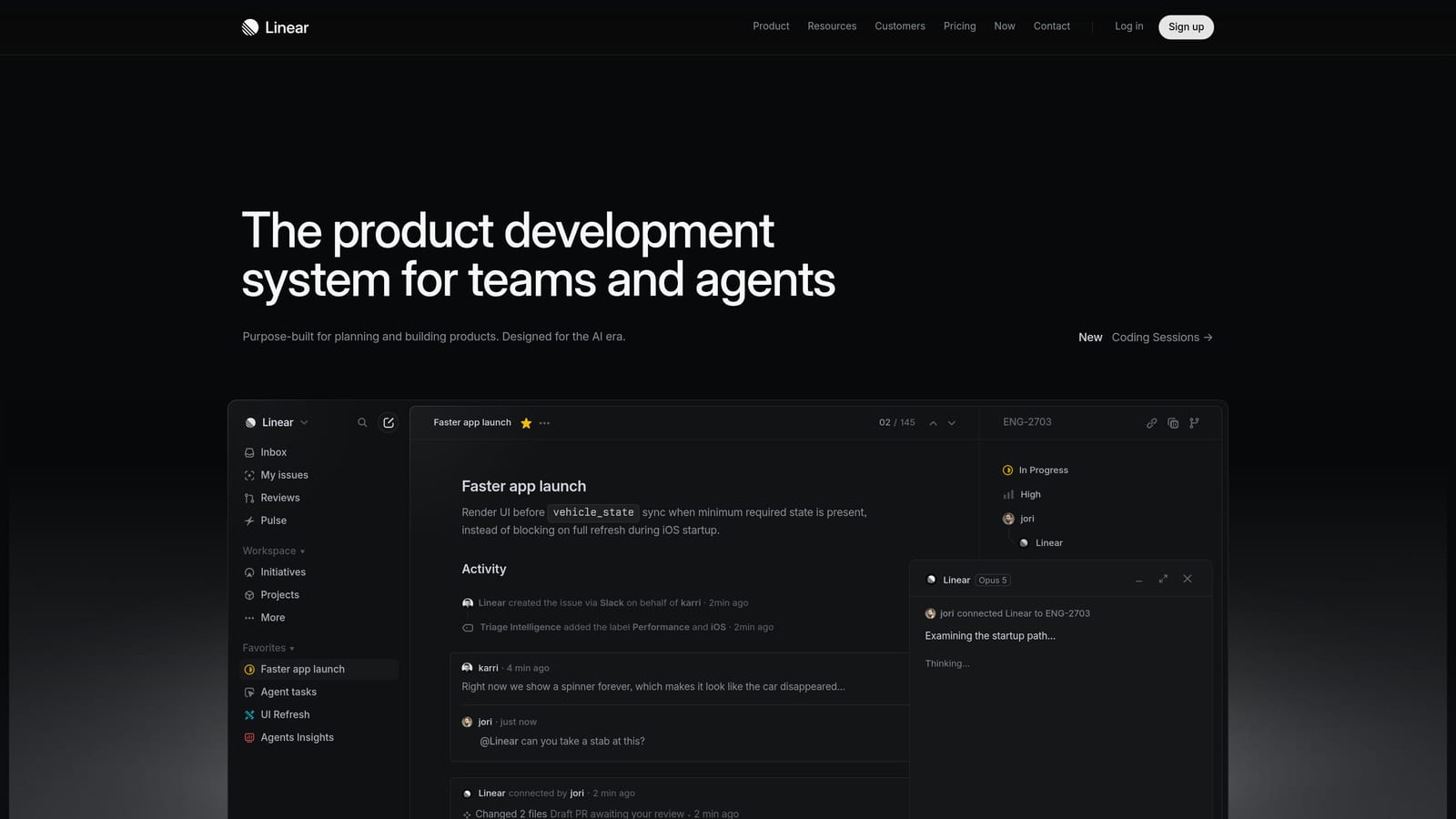
Linear is the project management tool of choice for engineering teams, and when connected to an AI helpdesk, it becomes the critical bridge between customer support and your development workflow.
Where This Tool Shines
Linear isn't a helpdesk on its own, but it belongs on this list because it transforms what AI helpdesks can do for product teams. When an AI helpdesk like Halo AI automatically creates a structured bug report in Linear the moment a user surfaces an issue, the entire loop between customer experience and engineering closes without manual handoff.
Linear's API-first architecture makes deep integration with support tools straightforward. Its clean, fast issue tracking and cycle management give engineering teams a workspace they actually want to use, which means bug reports from support are more likely to get triaged and resolved rather than ignored in a cluttered project board.
Key Features
Fast Issue Tracking: Purpose-built for engineering teams with a UI optimized for speed and clarity.
API-First Architecture: Enables deep, reliable integration with AI helpdesks and other support tools.
Automated Issue Creation: Receives structured bug reports generated directly from support ticket data.
Cycle and Project Tracking: Connects individual issues to engineering sprints and roadmap milestones.
Slack and GitHub Integration: Full coverage of the developer workflow from issue creation to deployment.
Best For
Any product team using an AI helpdesk that supports Linear integration. The combination of AI-generated bug tickets and Linear's engineering workflow is one of the highest-leverage moves a product team can make to reduce friction between support and development.
Pricing
Free plan available; paid plans start at $8/user/month. Check linear.app for current pricing.
6. Help Scout
Best for: SaaS teams where support quality is a core brand differentiator and human touch matters
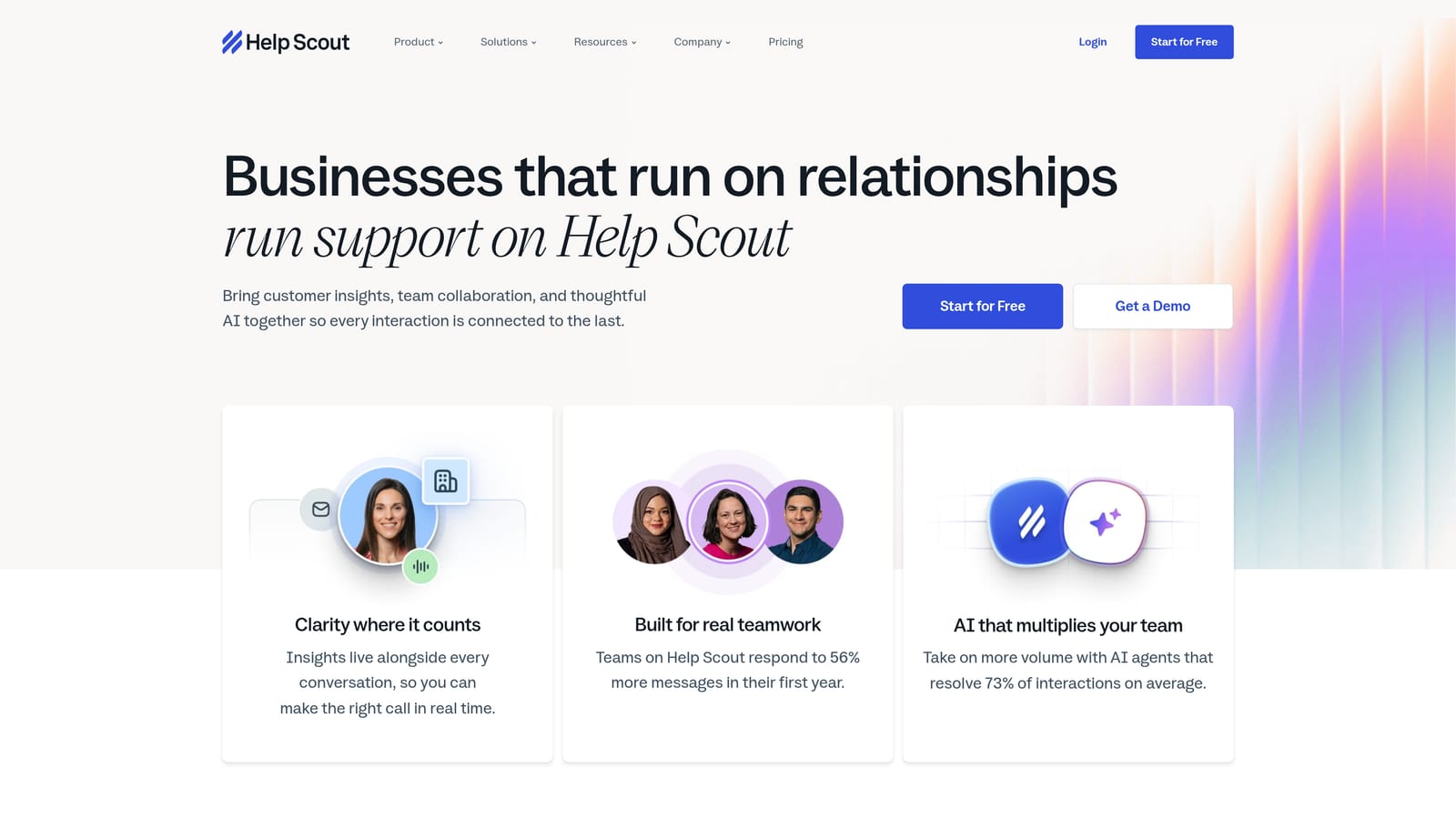
Help Scout is a human-centered support platform with AI features designed to augment agents rather than replace them.
Where This Tool Shines
Help Scout takes a deliberate approach to AI: use it to make agents faster and more effective, not to remove them from the equation entirely. AI Summarize gives agents instant context on long conversation threads. AI Assist helps draft and refine replies. AI Answer deflects common questions through the knowledge base before they ever reach an agent.
The result is a platform that feels genuinely collaborative rather than automated. For product teams where support interactions are relationship-building moments with high-value customers, that philosophy matters. The Docs knowledge base integrates tightly with the shared inbox, keeping self-service content and agent-assisted support in the same ecosystem.
Key Features
AI Summarize: Instantly condenses long conversation threads so agents can get up to speed without reading every message.
AI Assist: Drafts replies and adjusts tone to match your brand voice, reducing agent writing time.
AI Answer: Deflects common questions through the knowledge base before they reach the queue.
Docs Integration: Knowledge base tightly connected to the shared inbox for seamless self-service coverage.
Shared Inbox UX: Clean collaboration features including private notes, assignments, and conversation tagging.
Best For
SaaS companies where high-quality, personalized support is a competitive advantage. Particularly strong for teams with a dedicated support function that wants AI to enhance their work rather than automate it away.
Pricing
Starts at $50/month for 3 users. Check helpscout.com for current pricing.
7. Guru
Best for: Product teams with distributed support responsibilities who need knowledge surfaced in any workflow
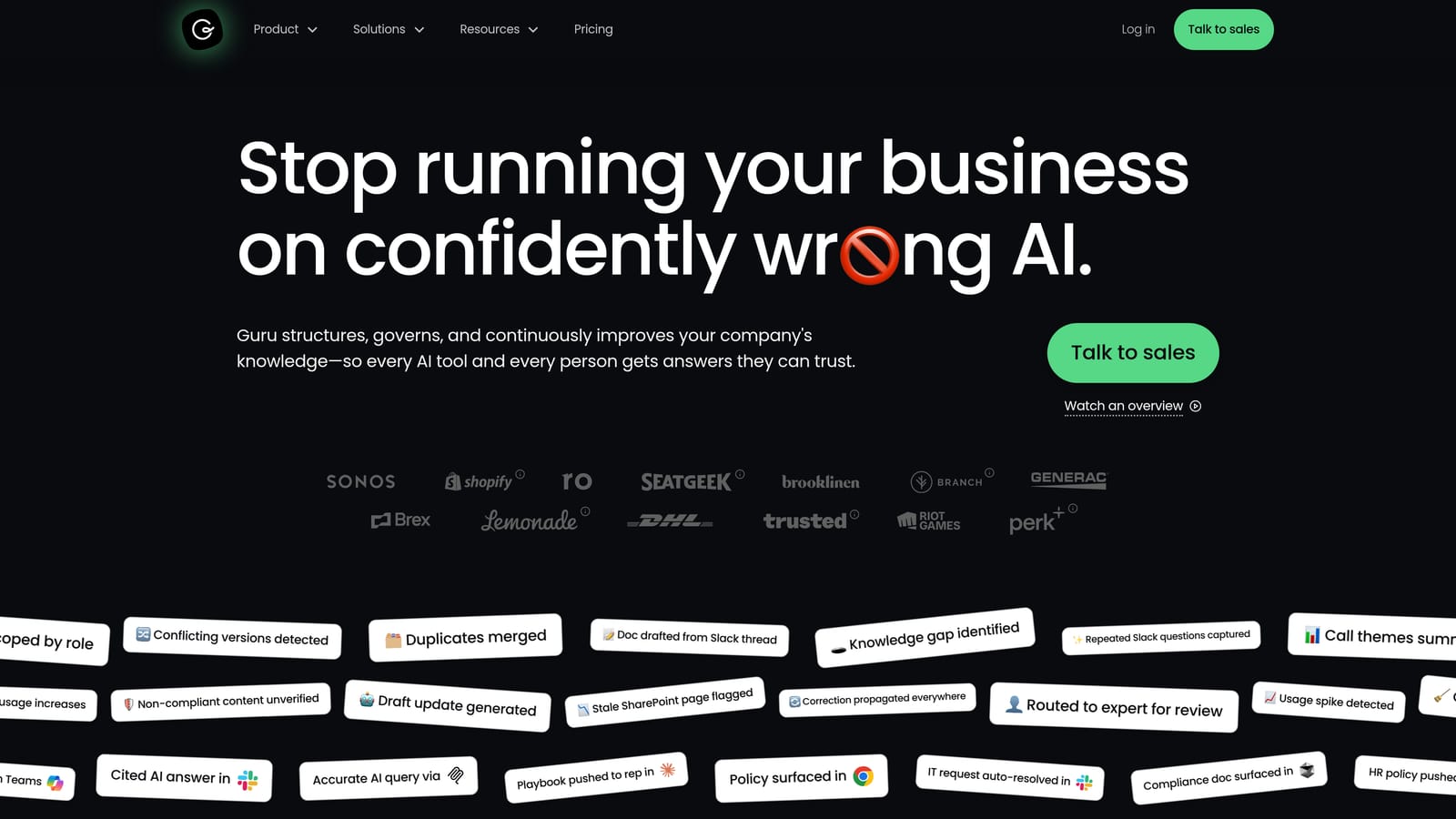
Guru is an AI-powered knowledge management platform that surfaces the right answers inside Slack, your browser, or any tool your team already uses.
Where This Tool Shines
Many product teams don't have a centralized support function. Support responsibilities are distributed across customer success, product, and sales — and the problem isn't that knowledge doesn't exist, it's that it lives in too many places. Guru solves this by creating a single searchable knowledge layer that appears wherever your team is working.
The browser extension and Slack integration mean team members can surface accurate answers without switching context. Knowledge verification workflows ensure content stays accurate over time, which is particularly valuable for fast-moving product teams where documentation can quickly become stale. Analytics on search patterns also reveal where knowledge gaps exist, which itself becomes useful product input.
Key Features
AI-Powered Knowledge Search: Searches across all company content to surface the most relevant answer to any query.
Browser Extension: Surfaces answers in any tool without requiring a context switch.
Slack Integration: Delivers knowledge retrieval directly inside team conversations.
Verification Workflows: Keeps knowledge base content accurate with scheduled review cycles.
Search Analytics: Identifies knowledge gaps and frequently searched topics to guide content creation.
Best For
Product teams where support is a shared responsibility across multiple roles, or organizations that need a knowledge layer connecting their AI helpdesk to internal documentation, runbooks, and product information.
Pricing
Free plan available; paid plans start around $10/user/month. Check getguru.com for current pricing.
8. Tidio
Best for: Early-stage product teams that want AI support without enterprise complexity or cost
Tidio is an accessible AI chat platform with the Lyro AI agent at its core, built for teams that want autonomous resolution without a lengthy implementation process.
Where This Tool Shines
Tidio's appeal is simplicity. Setup is quick, configuration is minimal, and Lyro AI can start handling common queries autonomously without an extensive training period. For early-stage SaaS teams that are just beginning to deal with support volume, that low barrier to entry is genuinely valuable.
Lyro handles conversational resolution across a meaningful range of common questions, and the chatbot builder lets teams create custom conversation flows for product-specific scenarios. It's not the deepest tool on this list in terms of developer integrations or business intelligence, but for teams whose primary need is deflecting repetitive queries at an accessible price point, Tidio delivers.
Key Features
Lyro AI Agent: Autonomous conversational resolution of common customer questions with minimal setup.
Live Chat: Fast deployment with a clean interface and straightforward configuration.
Chatbot Builder: Visual tool for creating custom conversation flows tailored to your product.
SaaS and E-commerce Integrations: Connects with common platforms to pull in customer and order context.
Accessible Pricing: Entry-level pricing designed for teams that aren't yet at enterprise scale.
Best For
Early-stage SaaS teams that want to introduce AI-assisted support quickly and affordably. Less suited for complex B2B support workflows with deep engineering tool integration requirements, but an excellent starting point.
Pricing
Free plan available; Lyro AI starts around $29/month. Check tidio.com for current pricing.
9. Plain
Best for: Developer-focused product teams that find traditional helpdesks too heavyweight
Plain is a modern, API-first support tool built specifically for technical teams who want Slack-native, developer-friendly support workflows without the overhead of a legacy helpdesk.
Where This Tool Shines
Plain was built by people who found existing helpdesks frustrating to use and overcomplicated to configure. The result is a tool with a genuinely clean UX, an API-first architecture that enables deep product integration, and Slack-native workflows that match how technical teams actually communicate.
For developer tool companies and technically sophisticated SaaS products, Plain's customer timeline view provides full context per user without requiring agents to piece together information from multiple systems. The webhook and integration support means Plain can fit into custom workflows that more rigid platforms can't accommodate. It's a relatively newer entrant gaining traction specifically among developer-focused SaaS teams who want something lighter and more elegant than Zendesk or Intercom.
Key Features
API-First Architecture: Deep product integration capabilities designed for technically sophisticated teams.
Slack-Native Workflows: Support interactions happen where technical teams already work, reducing context switching.
Customer Timeline View: Full per-user context in a single view, including product events and prior interactions.
Clean Minimal UX: Designed to be fast and opinionated, reducing the configuration overhead of legacy platforms.
Webhook and Integration Support: Enables custom workflows that standard helpdesk integrations can't support.
Best For
Developer tool companies, API-first SaaS products, and technical teams that value elegant, lightweight tooling over feature-heavy enterprise platforms. Ideal for teams where support workflows need to be deeply embedded in the product itself.
Pricing
Contact Plain for current pricing. Check plain.com for details.
Which Tool Is Right for Your Team?
The honest answer is that the right tool depends on two things: where your team is in its growth journey, and how deeply you need support to connect with your engineering workflow.
Here's a quick-reference breakdown by team type:
Early-stage teams getting started with AI support: Tidio offers the fastest path to autonomous resolution at an accessible price. Freshdesk is a strong step up when you need multi-channel coverage without enterprise costs.
Teams where support quality is a brand differentiator: Help Scout's human-centered approach keeps agents in control while AI accelerates their work. Plain is worth exploring if your team is technical and finds legacy helpdesks frustrating.
Enterprise teams with complex operations: Zendesk remains the most configurable option with the broadest integration marketplace. Intercom is a strong choice if in-app messaging and onboarding need to live alongside support.
Product-led B2B SaaS teams that need support to feed the product: This is where the distinction between AI-layered and AI-first architectures matters most. Tools like Zendesk, Freshdesk, and Intercom have added AI to existing helpdesk foundations. Halo AI was built the other way around: AI-first, with page-aware context, auto bug ticket creation routed to Linear, and a smart inbox that surfaces business intelligence signals alongside support metrics.
If your team lives in Linear, Slack, and GitHub, and you need every support interaction to generate product intelligence rather than just close a ticket, the architecture of your helpdesk matters as much as its feature list. A tool that was designed for a traditional support center will require significant configuration to behave like a product intelligence system. A tool built for that purpose from day one won't.
Your support team shouldn't scale linearly with your customer base. Let AI agents handle routine tickets, guide users through your product, and surface business intelligence while your team focuses on complex issues that need a human touch. See Halo in action and discover how continuous learning transforms every interaction into smarter, faster support.