9 Best AI Customer Support Platforms Compared for 2026
This ai customer support platform comparison evaluates nine leading solutions across AI architecture, integration depth, escalation handling, and total cost of ownership to help B2B SaaS teams and product teams identify the right fit. Each platform is assessed on genuine strengths and trade-offs, cutting through market noise to match specific use cases—from autonomous AI agents to chatbot add-ons—with resolution rates and customer satisfaction in mind.
 Grant CooperFounder13 min read
Choosing an AI customer support platform has never been more consequential, or more confusing. The market has exploded with options ranging from bolt-on chatbots to fully autonomous AI agents, and the differences between them directly impact resolution rates, team efficiency, and customer satisfaction.
This comparison cuts through the noise. We evaluated nine leading platforms across key dimensions: AI architecture (native vs. bolt-on), integration depth, escalation handling, analytics quality, and total cost of ownership. Whether you're a B2B SaaS team outgrowing your helpdesk's native automation or a product team looking to deflect tickets without sacrificing experience quality, this guide maps the right tool to the right use case.
Each platform is assessed on its genuine strengths and trade-offs. No filler, no fluff.
1. Halo AI
Best for: B2B SaaS teams wanting AI-first autonomous support with deep product and business context
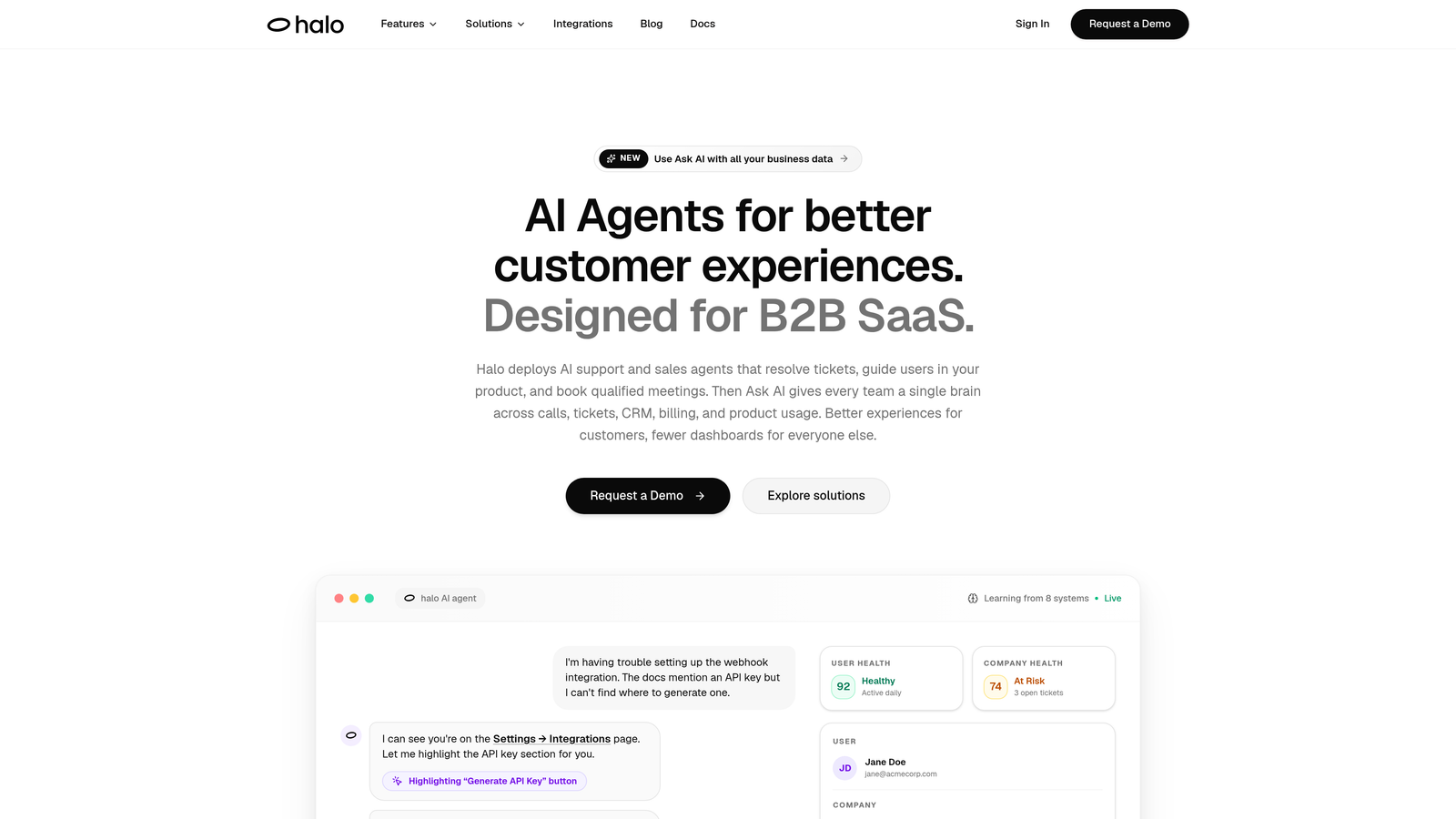
Halo AI is a purpose-built AI customer support platform that deploys autonomous agents to resolve tickets, guide users through your product, and surface business intelligence from every interaction.
Where This Tool Shines
What sets Halo apart from most platforms in this comparison is its AI-first architecture. Rather than layering AI onto an existing helpdesk infrastructure, Halo was built from the ground up around intelligent agents. This means the learning loop is native, not bolted on: every resolved interaction makes the system smarter.
The page-aware context is a genuine differentiator. Halo's chat widget sees what the user sees on screen, enabling visual UI guidance rather than generic text responses. For SaaS product teams where users often get stuck on specific UI flows, this is the kind of contextual intelligence that separates real resolution from ticket deflection to a dead end.
Key Features
Page-Aware Chat Widget: The AI understands which page or product state the user is on and provides contextually relevant visual guidance, not generic answers.
Continuous Learning Loop: Every resolved interaction feeds back into the AI, improving accuracy and resolution rates over time without manual retraining.
Auto Bug Ticket Creation: Halo automatically identifies and routes bug reports to Linear, Jira, or Slack, removing a manual step that typically falls through the cracks.
Smart Inbox with Business Intelligence: Goes beyond support metrics to surface customer health signals, anomaly detection, and revenue intelligence directly from support interactions.
Live Agent Handoff: When escalation is needed, full conversation context is preserved and passed to the human agent, eliminating the frustrating "start over" experience.
Deep Integrations: Connects to Linear, Slack, HubSpot, Intercom, Stripe, Zoom, PandaDoc, and Fathom, meaning support data flows into your entire business stack.
Best For
B2B SaaS product teams and customer success organizations that want AI agents capable of genuine autonomous resolution, not just deflection. Particularly strong for teams whose support conversations carry business intelligence value beyond the ticket itself.
Pricing
Contact Halo AI directly for pricing. Given the platform's enterprise-grade integrations and AI-first architecture, pricing is custom based on volume and use case.
2. Intercom
Best for: SaaS teams already in the Intercom ecosystem wanting AI layered onto familiar infrastructure
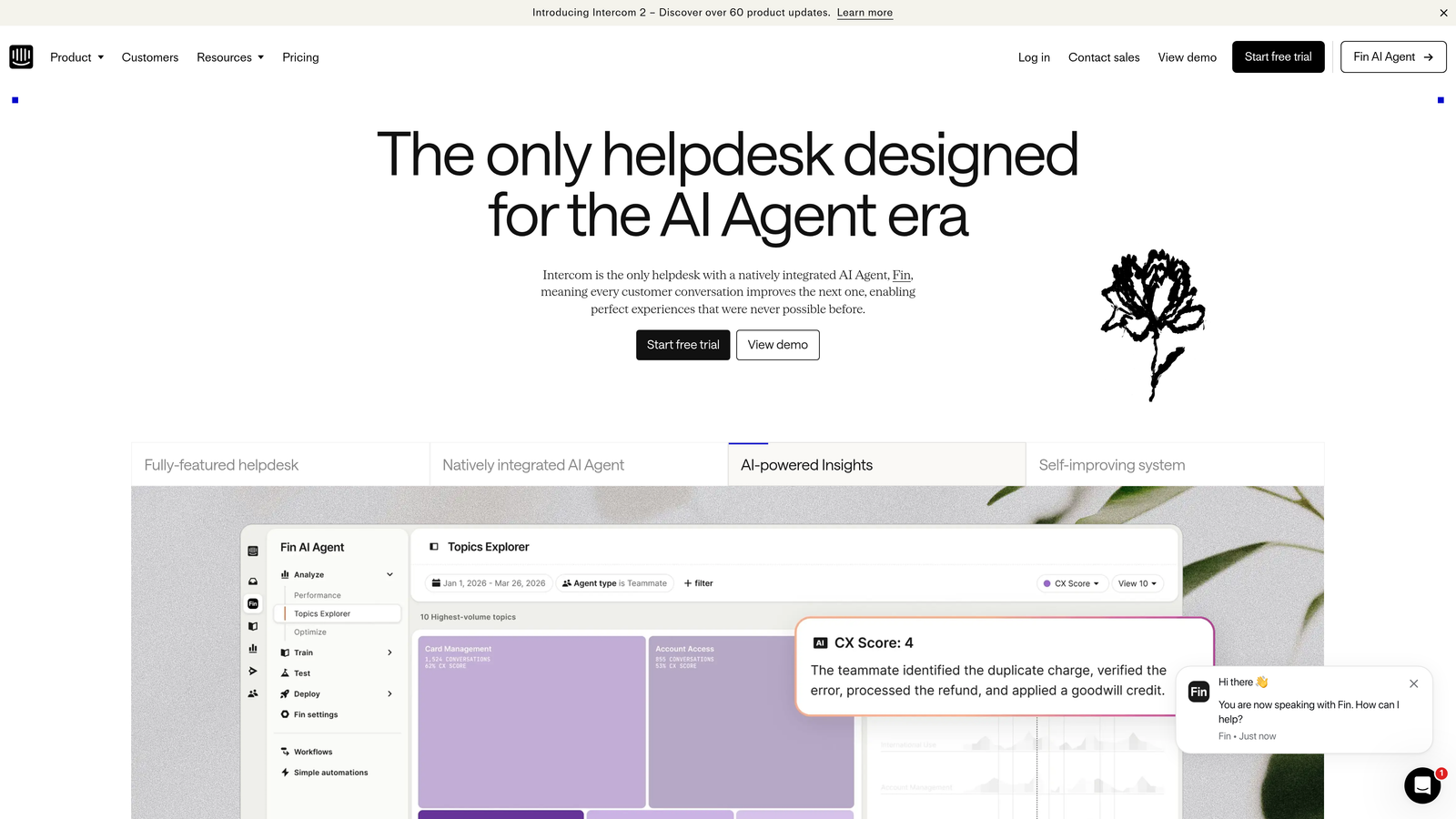
Intercom is a mature customer messaging and support platform with its Fin AI agent providing automated ticket resolution built on a well-established infrastructure used by thousands of SaaS companies.
Where This Tool Shines
Intercom's greatest strength is its ecosystem depth. If your team already uses Intercom for customer messaging, adding Fin AI is a natural extension rather than a platform migration. Fin is trained on your knowledge base and help center content, which means setup is relatively straightforward for teams with well-documented support content.
The omnichannel inbox is genuinely polished, covering email, chat, social, and SMS in a unified view. For teams that value familiarity and don't want to rip and replace their existing support stack, Intercom offers a credible AI upgrade path.
Key Features
Fin AI Agent: Trained on your existing knowledge base and help center, Fin handles common queries with conversational responses before routing to human agents.
Omnichannel Inbox: Unified view across email, chat, social, and SMS with conversation routing and assignment rules.
App Marketplace: Over 300 integrations available, giving teams flexibility to connect their existing tools.
Conversation Routing: Rule-based and AI-assisted routing to direct conversations to the right team or agent.
Reporting and CSAT: Built-in measurement for customer satisfaction and support performance metrics.
Best For
Teams already invested in the Intercom ecosystem who want to add AI capabilities without switching platforms. Less ideal for teams seeking AI-first architecture or deep business intelligence beyond support metrics.
Pricing
Starter plan available for smaller teams. Fin AI is priced per resolution on higher tiers, which can create unpredictable costs at scale. Verify current rates at intercom.com.
3. Zendesk AI
Best for: Large enterprise support organizations with complex workflows and compliance requirements
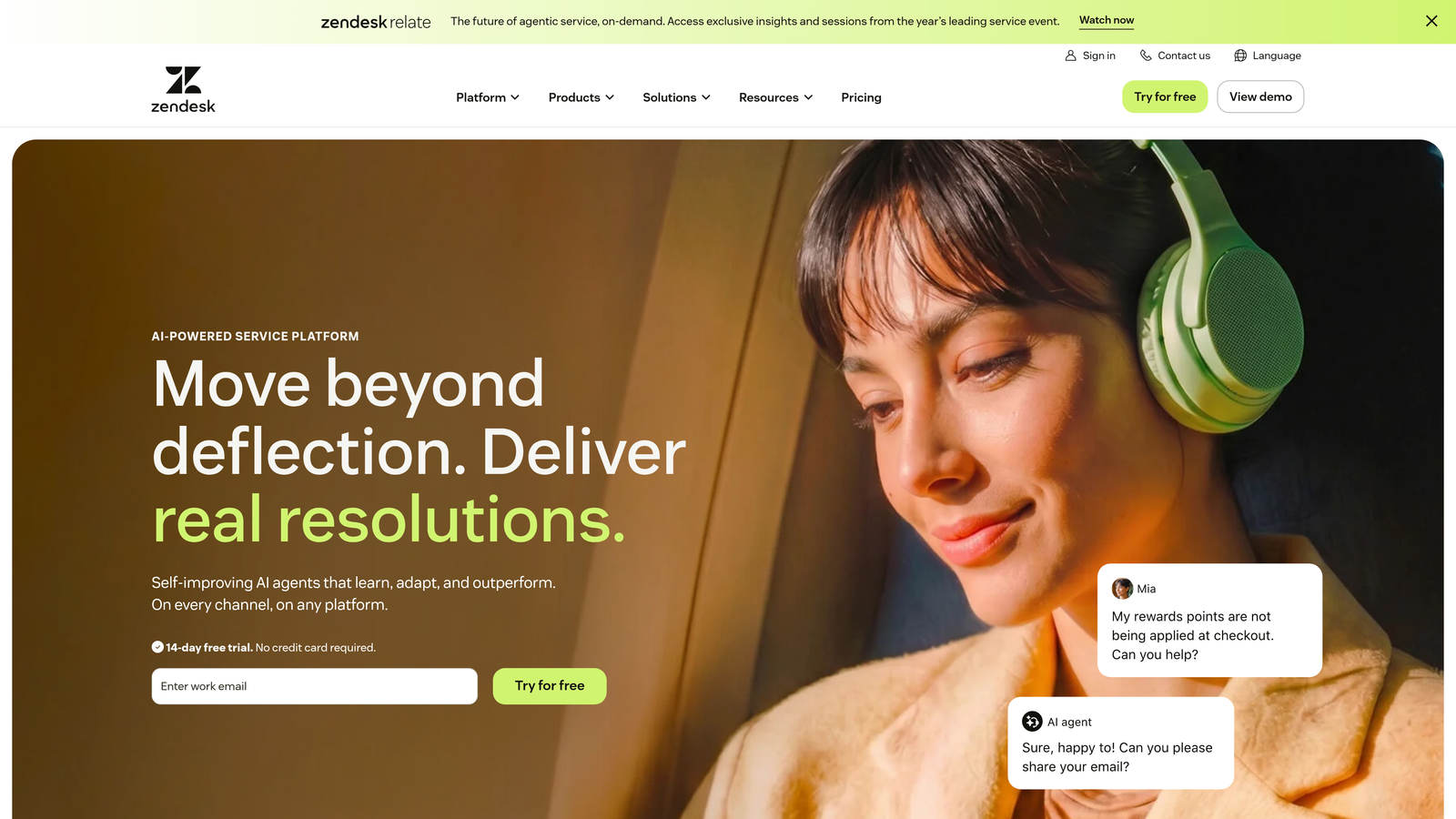
Zendesk is the enterprise helpdesk standard, with AI capabilities layered across ticketing, triage, agent assistance, and self-service for large support organizations.
Where This Tool Shines
Zendesk's depth of workflow customization is unmatched in this comparison. For enterprise teams managing hundreds of agents, complex SLA requirements, and multi-tiered escalation trees, Zendesk's infrastructure is purpose-built for that complexity. The AI capabilities, including intelligent triage, suggested replies, and macro recommendations, slot into existing workflows rather than requiring process reinvention.
The trade-off is weight. Zendesk can feel heavyweight for smaller teams, and the AI features are add-ons rather than core architecture. Teams evaluating Zendesk AI should assess whether they're paying for AI capability or for Zendesk's broader enterprise infrastructure.
Key Features
Intelligent Triage: AI classification for automatic ticket routing based on intent, sentiment, and priority signals.
AI-Generated Suggested Replies: Macro recommendations and reply suggestions surfaced to agents in context, reducing handle time.
Answer Bot: Self-service deflection that surfaces relevant help center articles before a ticket is submitted.
SLA Management: Robust compliance tooling for teams with strict response time and escalation requirements.
Custom Reporting: Extensive dashboard capabilities for teams that need granular performance visibility.
Best For
Large enterprise support teams with complex workflows, multi-tier escalation requirements, and existing Zendesk infrastructure investments. Overkill for smaller teams or those seeking AI-first autonomous resolution.
Pricing
Suite plans with AI add-ons; pricing scales by agent seats and AI usage volume. Can become expensive at scale. Confirm current pricing at zendesk.com.
4. Freshdesk (Freddy AI)
Best for: SMB teams wanting omnichannel support with AI assistance at an accessible price point
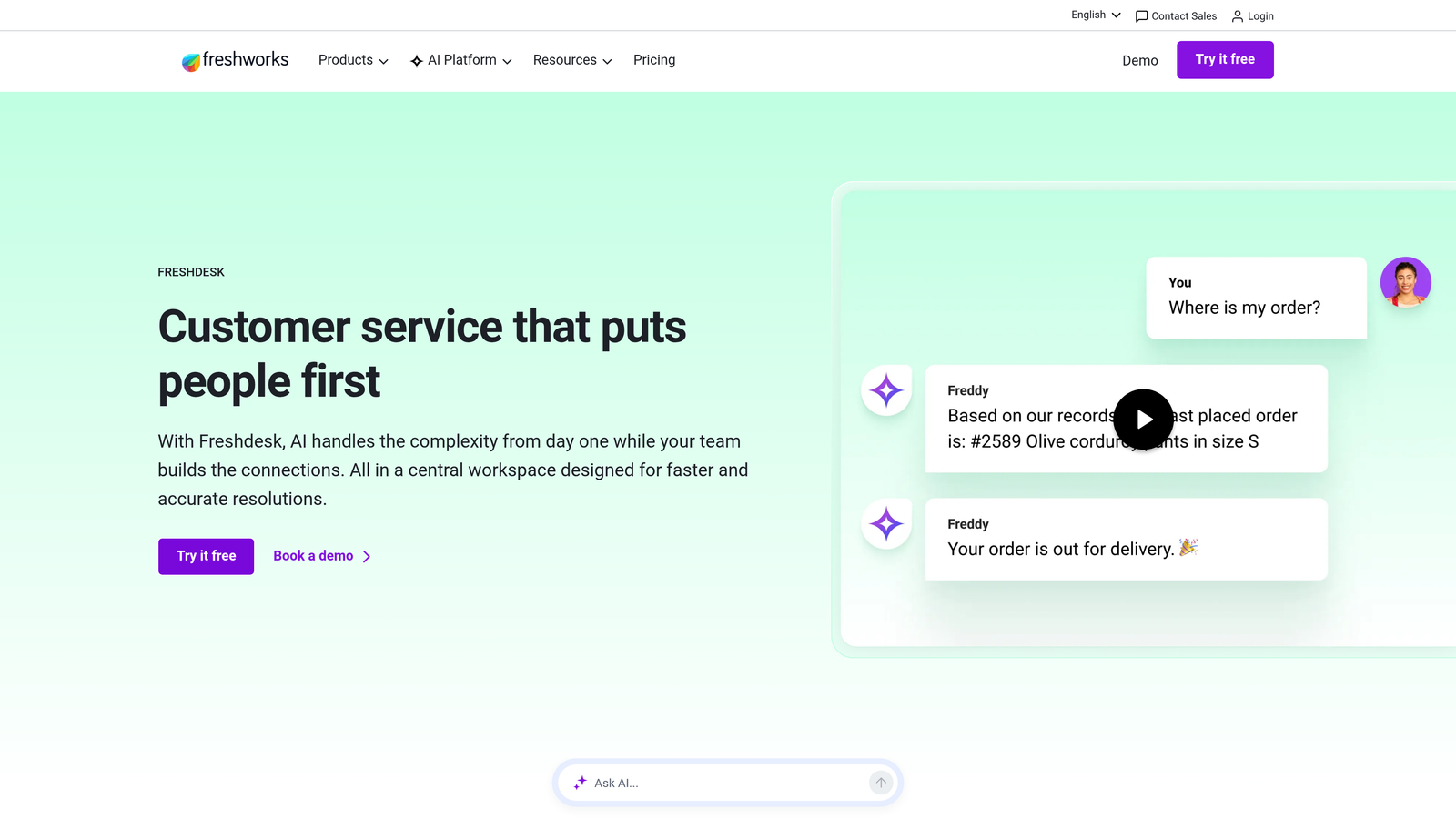
Freshdesk is Freshworks' SMB-friendly helpdesk suite, with Freddy AI providing answer bot deflection, agent copilot suggestions, and analytics insights across omnichannel support infrastructure.
Where This Tool Shines
Freshdesk's strongest card is accessibility. The free tier makes it genuinely viable for small teams, and the Freddy AI features unlock progressively as teams move up pricing tiers. Freddy Copilot's in-context suggestions and conversation summaries give agents a meaningful productivity boost without requiring full AI autonomy.
Omnichannel coverage is solid, spanning email, chat, phone, and social. For teams that need broad channel coverage without enterprise-level spend, Freshdesk hits a practical middle ground. The AI capabilities are generally considered less sophisticated than AI-first platforms, but for teams where human agents remain central, that trade-off is often acceptable.
Key Features
Freddy Answer Bot: Automated ticket deflection that handles common queries before they reach a human agent.
Freddy Copilot: In-context agent suggestions, conversation summaries, and response drafting assistance.
Freddy Insights: Support analytics and trend detection to surface patterns in ticket volume and resolution data.
Omnichannel Coverage: Email, chat, phone, and social channels managed from a unified interface.
Free Tier: Available for small teams, making Freshdesk a low-risk entry point for teams new to helpdesk software.
Best For
SMB teams and growing startups that need solid omnichannel helpdesk functionality with AI assistance at an affordable entry price. Teams with high autonomous resolution requirements may find Freddy AI's capabilities limiting.
Pricing
Free tier available. Freddy AI features unlock from the Growth plan upward. Verify current tier pricing at freshworks.com.
5. Tidio
Best for: E-commerce and SMB teams wanting fast setup with conversational AI and no coding required
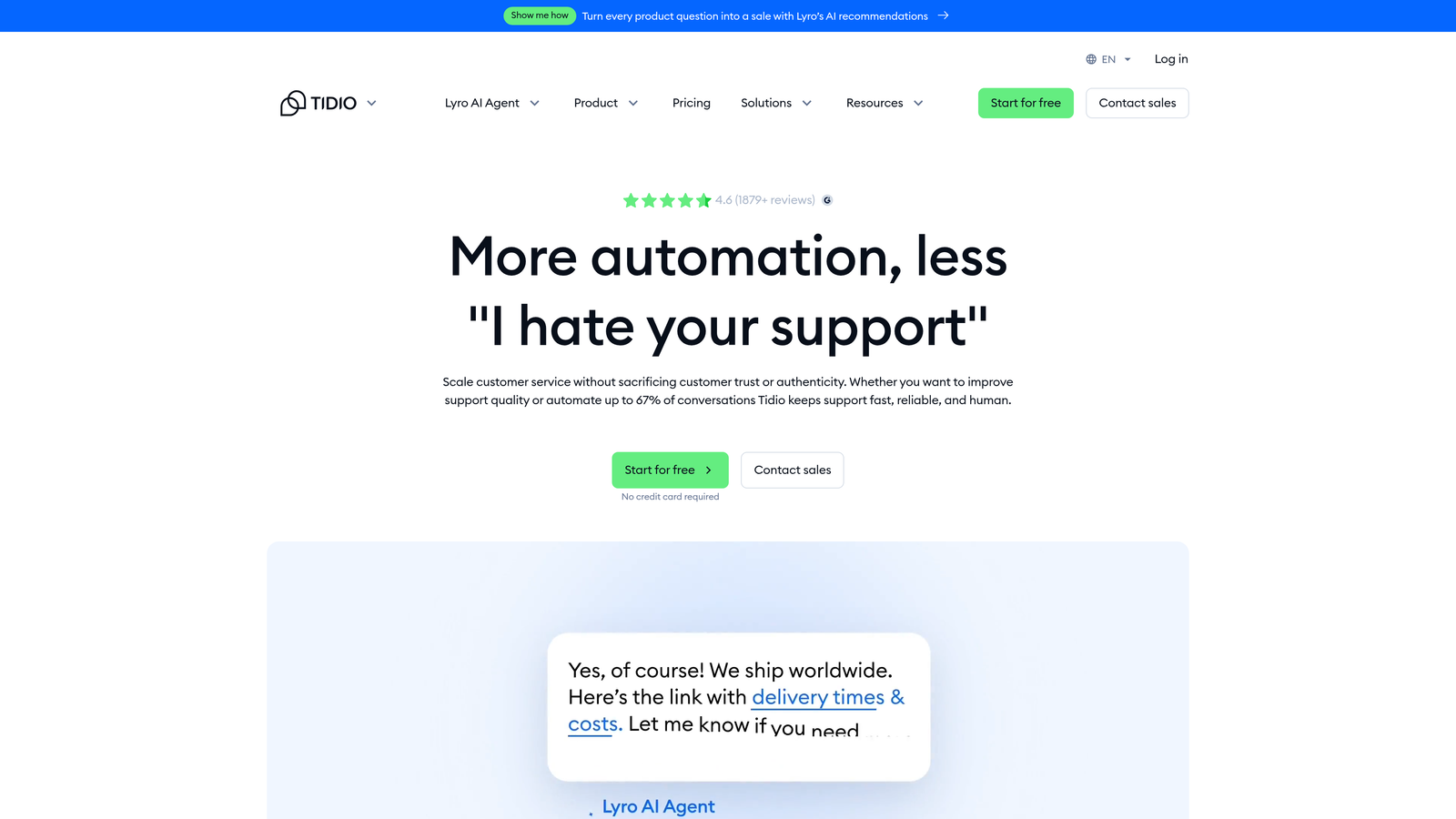
Tidio is a fast-setup live chat and AI platform popular with e-commerce teams, featuring Lyro AI for conversational automation and a visual flow builder designed for non-technical users.
Where This Tool Shines
Speed to value is Tidio's defining characteristic. Teams can go from signup to a live AI chatbot in a matter of hours, not weeks. The visual flow builder requires no coding knowledge, and native Shopify and WooCommerce integrations mean e-commerce teams can connect product and order data without custom development work.
Lyro AI handles conversational support automation effectively for common query types. For B2B SaaS teams with complex product workflows, Tidio's capabilities can feel limited, but for e-commerce and consumer-facing SMBs, it delivers practical automation without technical overhead.
Key Features
Lyro AI: Conversational AI for automated customer support, trained on your FAQ and help content.
Visual Flow Builder: No-code chatbot builder with drag-and-drop logic for teams without development resources.
E-Commerce Integrations: Native Shopify and WooCommerce connections for order lookup and product-related queries.
Live Chat with Proactive Triggers: Visitor tracking and behavior-based triggers to initiate conversations at the right moment.
Free Plan: Available for low-volume teams, making it accessible for early-stage businesses.
Best For
E-commerce brands and SMBs that prioritize fast deployment, ease of use, and Shopify or WooCommerce integration. Not the right fit for complex B2B support workflows or teams requiring deep business intelligence from support data.
Pricing
Free plan available for low-volume teams. Lyro AI is available on paid plans starting from approximately $29 per month. Confirm current pricing at tidio.com.
6. Drift (Salesloft)
Best for: B2B revenue teams where support, sales qualification, and pipeline generation overlap in the same conversation
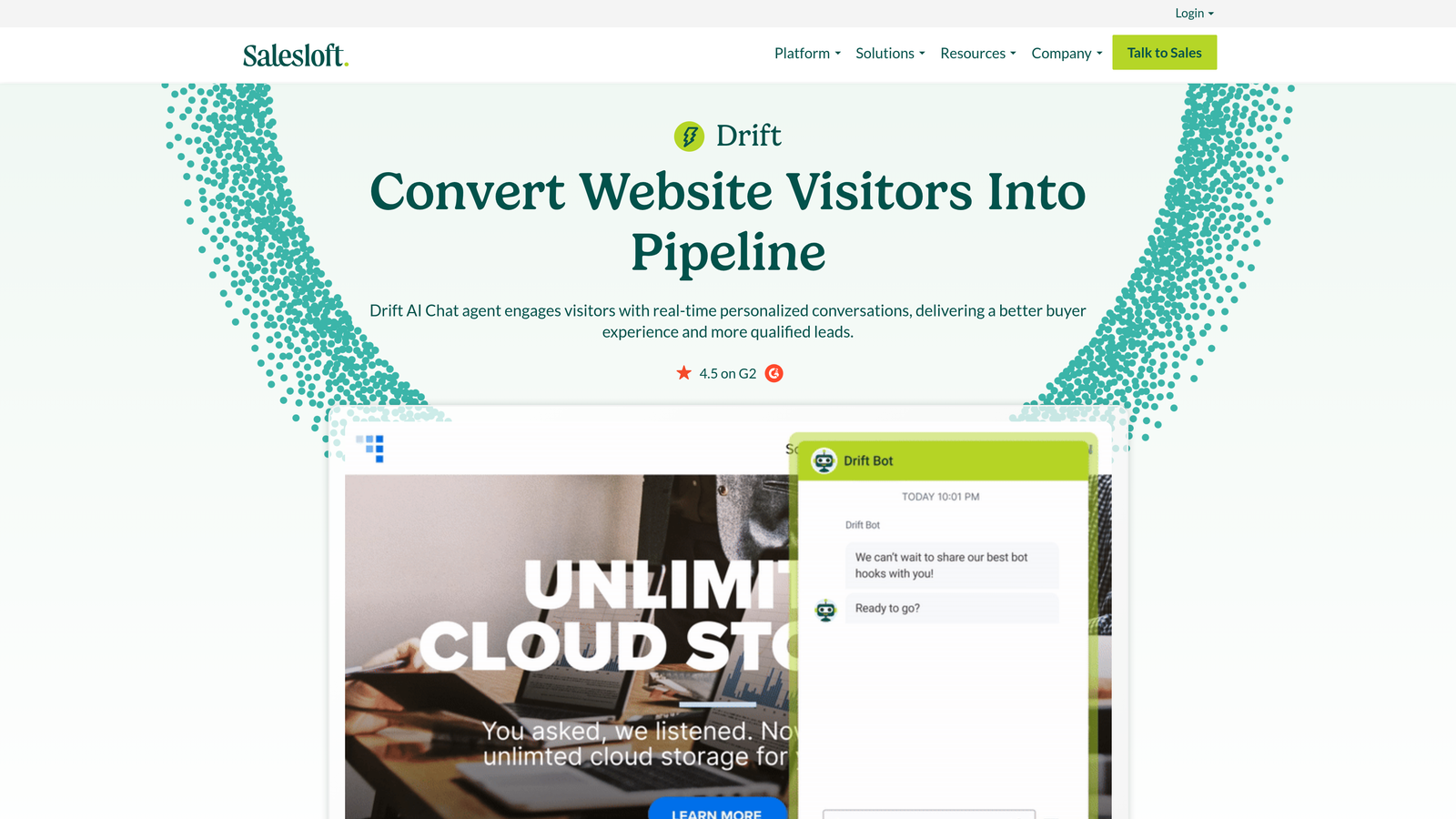
Drift is a conversational platform now integrated within Salesloft's revenue intelligence suite, designed for B2B teams where customer conversations span both support and sales contexts.
Where This Tool Shines
Drift's integration into Salesloft makes it genuinely distinctive for B2B revenue teams. When a support conversation reveals an upsell opportunity or a prospect's product question signals buying intent, Drift routes that intelligence directly into the sales pipeline. No other platform in this comparison handles the support-to-sales handoff as natively.
Account-based targeting and personalized conversation routing allow teams to treat inbound conversations differently based on company size, account status, or deal stage. For teams where support and sales qualification happen in the same chat window, Drift's positioning makes sense. Pure support teams with no sales overlap will likely find better value elsewhere.
Key Features
AI-Powered Conversational Bots: Handles both support queries and sales qualification within the same conversation flow.
Salesloft CRM Integration: Revenue-tied conversation data flows directly into Salesloft for pipeline tracking and deal influence reporting.
Account-Based Targeting: Personalized conversation routing based on company identity, account tier, or deal stage.
Meeting Scheduling: Automated calendar booking within the chat interface, eliminating back-and-forth for sales follow-ups.
Conversation Intelligence: Reporting on how conversations influence pipeline and deal outcomes.
Best For
B2B companies where sales and support conversations are genuinely intertwined, particularly teams already using Salesloft. Not recommended as a pure customer support solution for teams without a sales qualification use case.
Pricing
Enterprise pricing model. Contact Drift or Salesloft sales directly for current rates at drift.com.
7. Kustomer
Best for: High-volume consumer brands needing a unified customer timeline with AI automation layered on top
Kustomer is a CRM-native customer service platform owned by Meta, offering a unified customer timeline view with AI automation built for consumer brands managing complex order and interaction histories.
Where This Tool Shines
The unified customer timeline is Kustomer's most compelling feature. Agents see a complete view of every prior interaction, order, return, and communication in a single interface, without switching between systems. For high-volume consumer brands where context is everything, this eliminates the "can you repeat your order number" experience that erodes customer trust.
AI automation handles routing, tagging, and resolution suggestions on top of this rich data model. Kustomer is less well-suited for pure B2B SaaS use cases, where the CRM data model (built around consumer transaction history) may not map cleanly to product-led or subscription contexts.
Key Features
Unified Customer Timeline: All interactions, orders, and history consolidated in a single agent view, eliminating context switching.
AI Automation: Routing, tagging, and resolution suggestions powered by AI, reducing manual triage work.
Omnichannel Support: Email, chat, voice, social, and SMS managed from the unified interface.
CRM Data Model: Rich customer context at scale, particularly valuable for brands with complex purchase and return histories.
SLA Management: Reporting and compliance tooling for teams with response time requirements.
Best For
High-volume consumer brands, retail, and DTC companies where agent context and customer history are critical. Less suited for B2B SaaS teams or those seeking AI-first autonomous resolution over agent-assist functionality.
Pricing
Per-agent monthly pricing model. Contact Kustomer for current rates at kustomer.com.
8. Ada
Best for: Enterprise organizations with strict governance, compliance, and multilingual support requirements
Ada is an enterprise-grade no-code AI agent builder offering strong governance controls, multilingual support, and broad channel coverage for large organizations with complex IT and compliance requirements.
Where This Tool Shines
Ada's governance architecture is its primary differentiator in enterprise contexts. Approval workflows, audit logs, SSO, and security certifications give IT and compliance teams the controls they need before deploying AI-facing customer interactions. For organizations in regulated industries or with strict brand guardrails, Ada's structure is reassuring rather than restrictive.
Multilingual support across a wide range of languages makes Ada practical for global enterprises that can't afford to deploy separate solutions by region. The no-code builder means business teams can manage and update the AI agent without engineering involvement, which reduces deployment bottlenecks in large organizations.
Key Features
No-Code AI Agent Builder: Enterprise governance and approval workflows built into the agent creation process.
Multilingual Support: Broad language coverage for global deployments without separate regional configurations.
Channel Coverage: Web, mobile, SMS, social, and voice channels supported from a single platform.
Generative AI with Guardrails: Brand and compliance controls on AI-generated responses to prevent off-brand or non-compliant outputs.
Enterprise Security: SSO, audit logs, and security certifications for organizations with strict IT requirements.
Best For
Large enterprises with compliance, governance, and multilingual requirements. Typically requires more setup time than lighter-weight platforms, but offers the control and auditability that enterprise IT teams require.
Pricing
Enterprise pricing. Contact Ada sales for current rates at ada.cx.
9. Forethought (Supportlogic)
Best for: Teams that want AI to augment human agents rather than replace them, with intelligent triage and routing
Forethought, acquired by Supportlogic in 2024, is an AI-powered support intelligence platform focused on augmenting human agents with intelligent triage, routing, and in-context suggestions rather than full autonomous resolution.
Where This Tool Shines
Forethought takes a deliberately different philosophical stance from most platforms in this comparison: AI as amplifier, not replacement. Agatha Assist surfaces relevant knowledge and suggested responses to agents in real time, reducing handle time without removing human judgment from the equation. For teams dealing with complex, high-stakes support interactions where full automation carries risk, this approach is genuinely valuable.
Sentiment and escalation risk detection add a proactive dimension, flagging conversations that are trending toward churn or escalation before they reach a breaking point. Integration with Zendesk, Salesforce, and ServiceNow means Forethought slots into existing enterprise helpdesk infrastructure rather than requiring replacement.
Key Features
AI Triage and Routing: Intelligent ticket routing based on predicted intent and urgency, reducing manual triage overhead.
Agatha Assist: Real-time agent suggestions and knowledge surfacing during live conversations.
Solve: Automated deflection for common queries, handling the volume that doesn't need human involvement.
Sentiment and Escalation Detection: Flags at-risk conversations before they deteriorate, enabling proactive intervention.
Helpdesk Integrations: Works within Zendesk, Salesforce, ServiceNow, and other major platforms rather than replacing them.
Best For
Enterprise teams that want AI to enhance human agent performance rather than operate autonomously. Strong fit for organizations with complex support scenarios where human judgment remains essential, and for teams already invested in Zendesk, Salesforce, or ServiceNow.
Pricing
Contact for pricing. Typically structured as enterprise agreements. Confirm current rates at forethought.ai.
Which Platform Is Right for Your Team?
The right choice depends less on feature lists and more on where your support organization is headed. Here's a quick map.
If you're a B2B SaaS team that wants AI-first autonomous resolution with business intelligence baked in: Halo AI is the strongest fit. Page-aware context, continuous learning, and integrations that span your entire business stack make it purpose-built for product-led companies where support data carries strategic value beyond the ticket queue.
If you're already deep in the Intercom or Zendesk ecosystem: Intercom's Fin AI or Zendesk AI offer the path of least resistance. You're trading AI-first architecture for familiarity and existing workflow continuity.
If you're an SMB or e-commerce brand with limited technical resources: Tidio or Freshdesk offer accessible entry points with solid AI assistance and fast deployment timelines.
If enterprise governance and multilingual scale are non-negotiable: Ada is built for exactly that context, with the compliance architecture to match.
If your support and sales conversations are genuinely intertwined: Drift within the Salesloft suite handles that overlap better than any other platform here.
Your support team shouldn't scale linearly with your customer base. AI agents should handle routine tickets, guide users through your product, and surface business intelligence while your team focuses on complex issues that need a human touch. See Halo in action and discover how continuous learning transforms every interaction into smarter, faster support.