9 Best AI Customer Service Tools to Follow Best Practices in 2026
Discover the 9 best AI customer service tools of 2026 that align with AI customer service best practices, from autonomous ticket resolution to intelligent human handoffs. This guide evaluates each platform on AI depth, escalation intelligence, and real-world utility to help support teams of any size improve customer satisfaction and operational efficiency.
 Matt PattoliFounder14 min read
AI customer service has moved well past the era of rigid chatbots and scripted FAQ bots. Today's best teams are using AI agents that resolve tickets autonomously, surface business intelligence, and hand off to humans at exactly the right moment, all while continuously learning from every interaction. But with dozens of platforms claiming to do it all, knowing which tools actually support genuine AI customer service best practices is the real challenge.
Context-awareness, smart escalation, continuous improvement, measurable outcomes: these are the practices that actually move the needle on customer satisfaction and team efficiency. This list cuts through the noise. Whether you're running a lean support team at a growing SaaS company or managing a high-volume helpdesk at scale, these tools represent the current best in class, evaluated on AI depth, integration breadth, escalation intelligence, and real-world utility.
1. Halo AI
Best for: SaaS and B2B teams wanting AI-first support with business intelligence built in
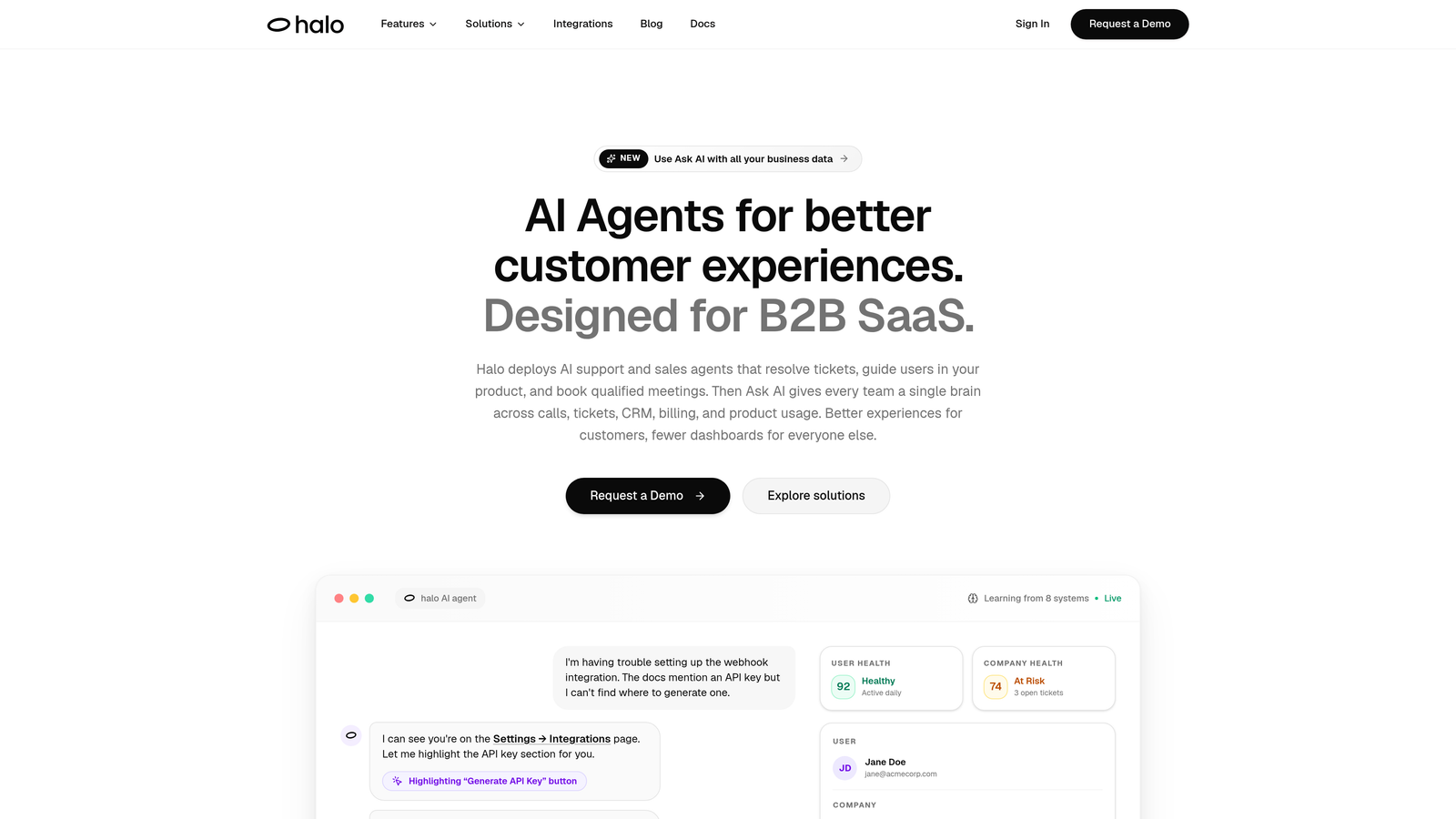
Halo AI is an AI-first customer support platform that deploys intelligent agents to resolve tickets, guide users through your product, and surface actionable business intelligence — all without bolting AI onto a legacy helpdesk.
Where This Tool Shines
What sets Halo apart is its architecture. Most platforms add AI features on top of existing helpdesk infrastructure. Halo was built AI-first, which means continuous learning isn't a feature toggle — it's baked into how the platform operates. Every resolved ticket, every escalation, every user interaction feeds back into the system to make the next response smarter.
The page-aware context capability is particularly compelling for SaaS teams. Rather than guessing what a user is struggling with, Halo's AI agents see exactly what the user sees: the specific page, the UI state, the workflow they're stuck in. That context translates into guidance that's precise rather than generic, reducing the back-and-forth that frustrates users and drains agent time.
Key Features
Page-Aware AI Agents: The AI sees what users see in your product, enabling visual UI guidance that's contextually accurate rather than scripted.
Smart Inbox with Business Intelligence: Surfaces customer health signals, revenue anomalies, and product insights from support data — turning your helpdesk into a strategic intelligence layer.
Auto Bug Ticket Creation: Automatically identifies and routes bug reports to Linear and connected dev tools, closing the loop between support and engineering without manual triage.
Live Agent Handoff: When escalation is needed, full conversation context is preserved so customers never have to repeat themselves.
Deep Integration Stack: Connects to Linear, Slack, HubSpot, Intercom, Stripe, Zoom, PandaDoc, and Fathom — meaning the AI can resolve more tickets without escalation by pulling relevant data from across your business.
Continuous Learning Architecture: Improves from every interaction, both resolved and escalated, so the system gets measurably smarter over time.
Best For
Halo is the strongest fit for B2B SaaS companies and product-led growth teams that want AI support to do more than deflect tickets. If your team needs support data to inform product decisions, connect to your revenue stack, and improve autonomously without constant manual retraining, Halo is built for exactly that use case.
Pricing
Visit haloagents.ai for current pricing details. Plans are tailored to team size and usage needs.
2. Intercom (Fin AI Agent)
Best for: Teams already on Intercom who want autonomous resolution without changing platforms
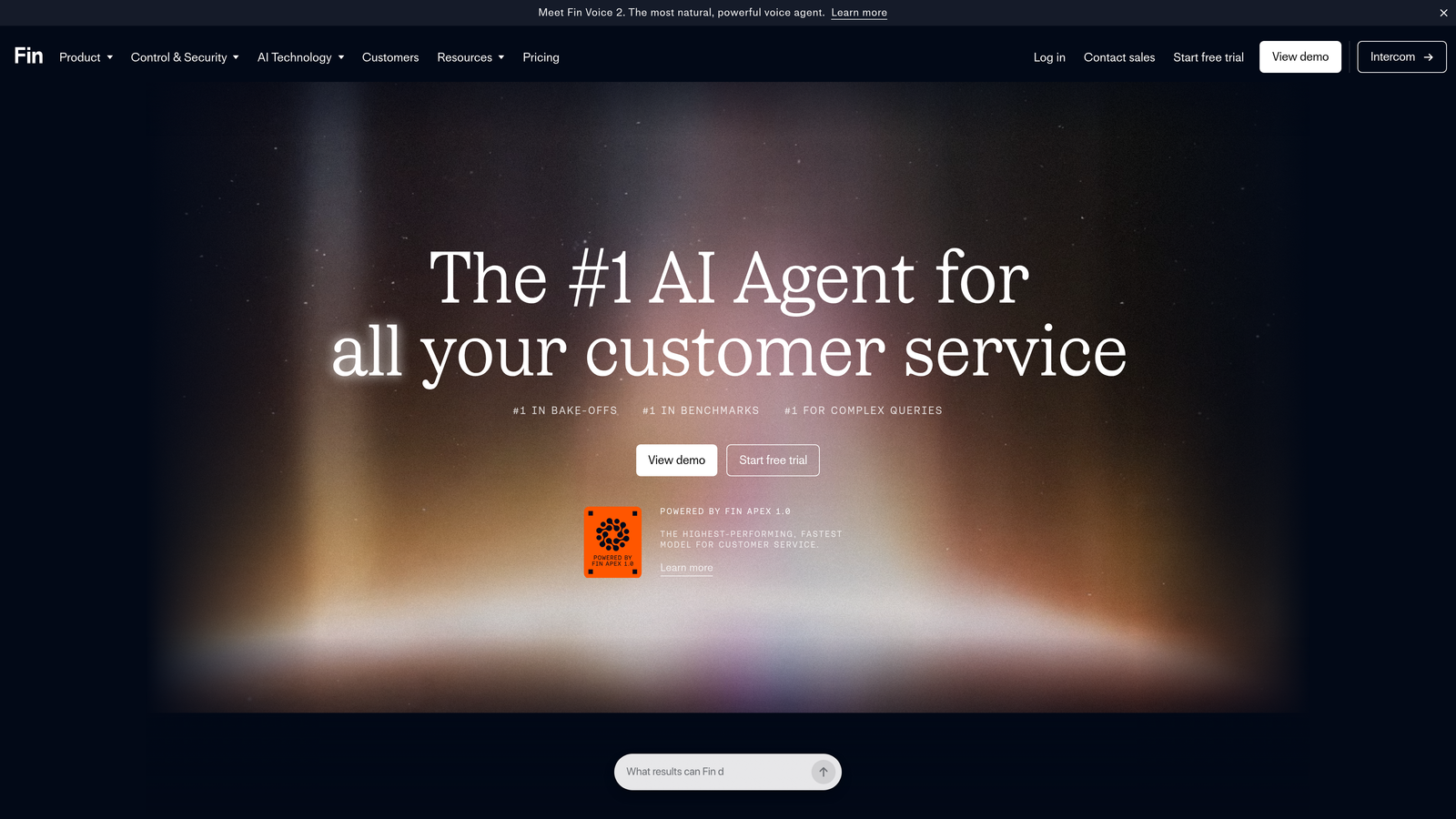
Intercom Fin is Intercom's native AI agent, autonomously resolving support queries using your knowledge base and product content, deeply embedded within the Intercom Messenger experience.
Where This Tool Shines
Fin's biggest advantage is how seamlessly it lives inside the Intercom ecosystem. If your team already uses Intercom Messenger, Articles, and Inbox, Fin slots in without any friction. It draws on multi-source knowledge including help center content, PDFs, and URLs, and handles a wide range of queries with natural, conversational responses.
The per-resolution pricing model is worth noting: you pay for outcomes rather than seats, which aligns costs directly with value delivered. For teams with predictable query volumes, this can be a meaningful shift from traditional per-seat licensing.
Key Features
Autonomous Resolution: Fin handles queries using your existing knowledge base, help center articles, and uploaded documents without requiring manual bot building.
Native Intercom Integration: Works directly within Intercom Inbox, Articles, and Messenger with no third-party setup required.
Human Handoff with Context: Escalates to live agents with full conversation history intact, so customers don't repeat themselves.
Per-Resolution Pricing: Costs scale with successful resolutions rather than team size, rewarding AI performance.
Multilingual Support: Handles queries across multiple languages, useful for global support teams.
Best For
Fin is the natural choice for teams already invested in the Intercom platform who want to add autonomous resolution without introducing a new vendor. It's less suited for teams that need deep business intelligence or cross-stack integrations beyond the Intercom ecosystem.
Pricing
Fin is charged per resolution on top of existing Intercom plan costs. Verify current rates at intercom.com.
3. Zendesk AI
Best for: Large support organizations needing enterprise-grade AI across an established helpdesk
Zendesk AI adds intelligent triage, intent and sentiment detection, agent copilot capabilities, and autonomous AI agents to the industry's most widely deployed helpdesk platform.
Where This Tool Shines
Zendesk's AI Suite benefits enormously from the platform's scale. Built on Zendesk's large proprietary CX dataset, the AI has been trained on more real-world support interactions than almost any competitor. That translates into intent detection and sentiment analysis that performs well across a wide range of industries and query types without heavy customization.
The agent copilot capabilities are particularly strong for high-volume teams. Suggested replies, ticket summarization, and next-best-action recommendations reduce cognitive load for agents handling dozens of tickets simultaneously, which is where enterprise support teams feel the most pressure.
Key Features
AI-Powered Triage: Automatically detects intent and sentiment to route tickets to the right team or workflow without manual intervention.
Agent Copilot: Provides suggested replies, ticket summaries, and next-best-action guidance to speed up agent resolution.
Autonomous AI Agents: Handles self-service resolution for common queries, reducing ticket volume before it reaches human agents.
Advanced Routing and Workflow Automation: Configurable rules and AI-driven logic handle complex routing scenarios at scale.
Proprietary CX Dataset: AI models trained on Zendesk's vast support interaction history deliver strong out-of-the-box performance.
Best For
Zendesk AI is best suited for established enterprise support organizations already on the Zendesk platform, or those evaluating it for the first time at scale. Teams looking for a standalone AI-first platform may find the AI Suite feels like an add-on rather than a core architecture.
Pricing
AI Suite is available as an add-on to Zendesk Suite plans. Verify current pricing at zendesk.com.
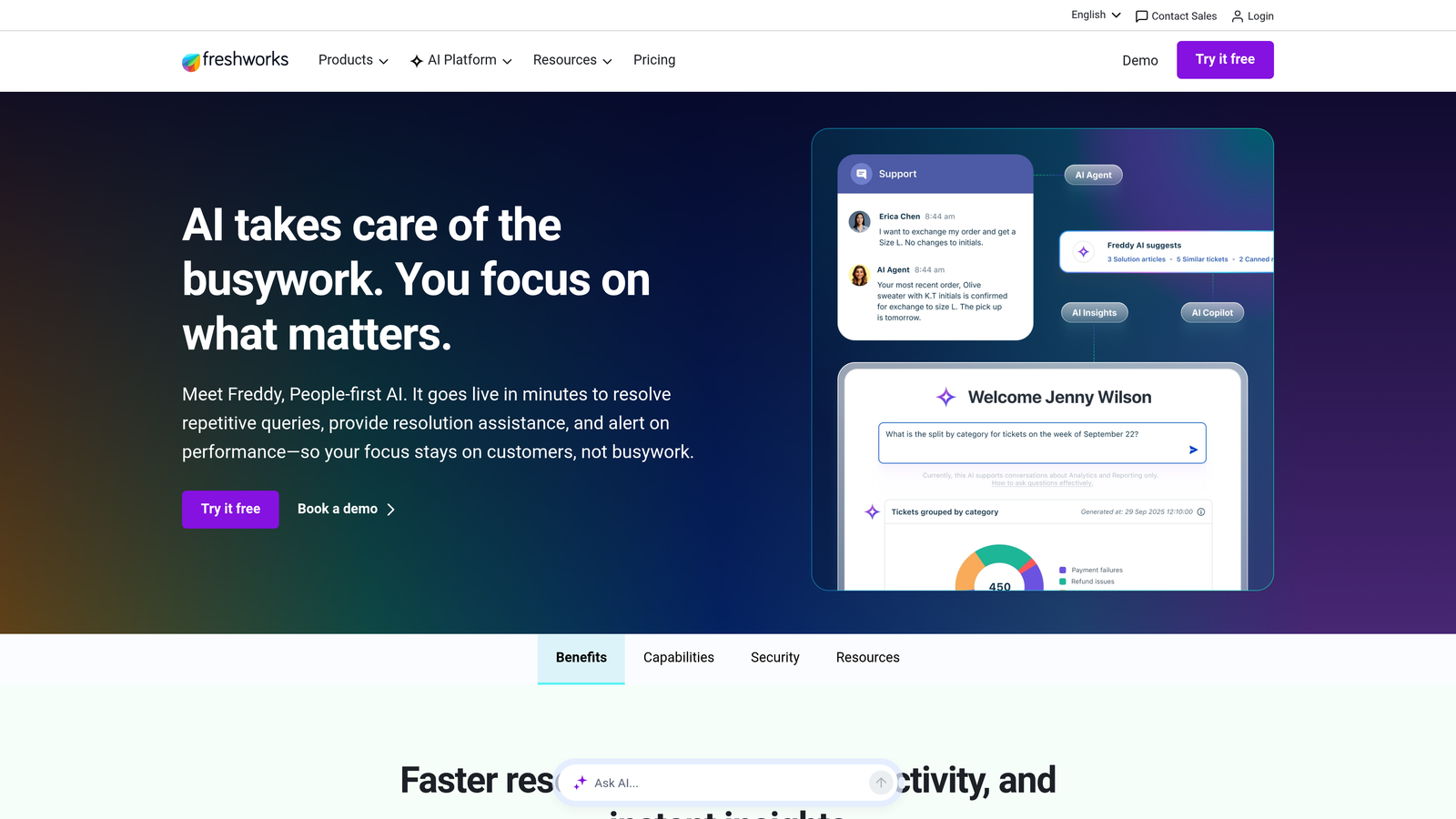
4. Freshdesk (Freddy AI)
Best for: Teams in the Freshworks ecosystem wanting unified AI across ticketing and messaging
Freddy AI is Freshworks' unified AI layer across Freshdesk and Freshchat, covering autonomous self-service, agent assist, and support analytics in one connected ecosystem.
Where This Tool Shines
Freddy AI's strongest value proposition is its span across the Freshworks product suite. Rather than deploying separate AI tools for ticketing and messaging, Freddy operates across both Freshdesk and Freshchat, giving teams a consistent AI experience regardless of which channel a customer uses. This unified approach reduces configuration overhead and keeps AI behavior consistent.
Freddy Insights adds a layer of analytics that many mid-market teams find genuinely useful. Anomaly detection and CSAT prediction give support managers early warning signals before issues compound, which aligns with the best practice of using support data proactively rather than reactively.
Key Features
Freddy Self Service: Autonomous deflection bot handling common queries via chat and email without agent involvement.
Freddy Copilot: Agent assist with suggested replies, conversation summarization, and CSAT prediction to improve agent efficiency.
Freddy Insights: Analytics layer with anomaly detection and support performance intelligence for managers.
Cross-Platform Consistency: Unified AI behavior across Freshdesk ticketing and Freshchat messaging in one ecosystem.
No-Code Bot Builder: Custom conversation flows without engineering resources, useful for teams with specific deflection needs.
Best For
Freddy AI delivers the most value for teams already using Freshdesk or Freshchat. If you're evaluating Freshworks as your primary support stack, Freddy is a compelling reason to stay in the ecosystem. Teams outside Freshworks will find better-integrated options elsewhere.
Pricing
Freddy AI is available as an add-on with pricing that varies by plan tier. Verify current options at freshworks.com.
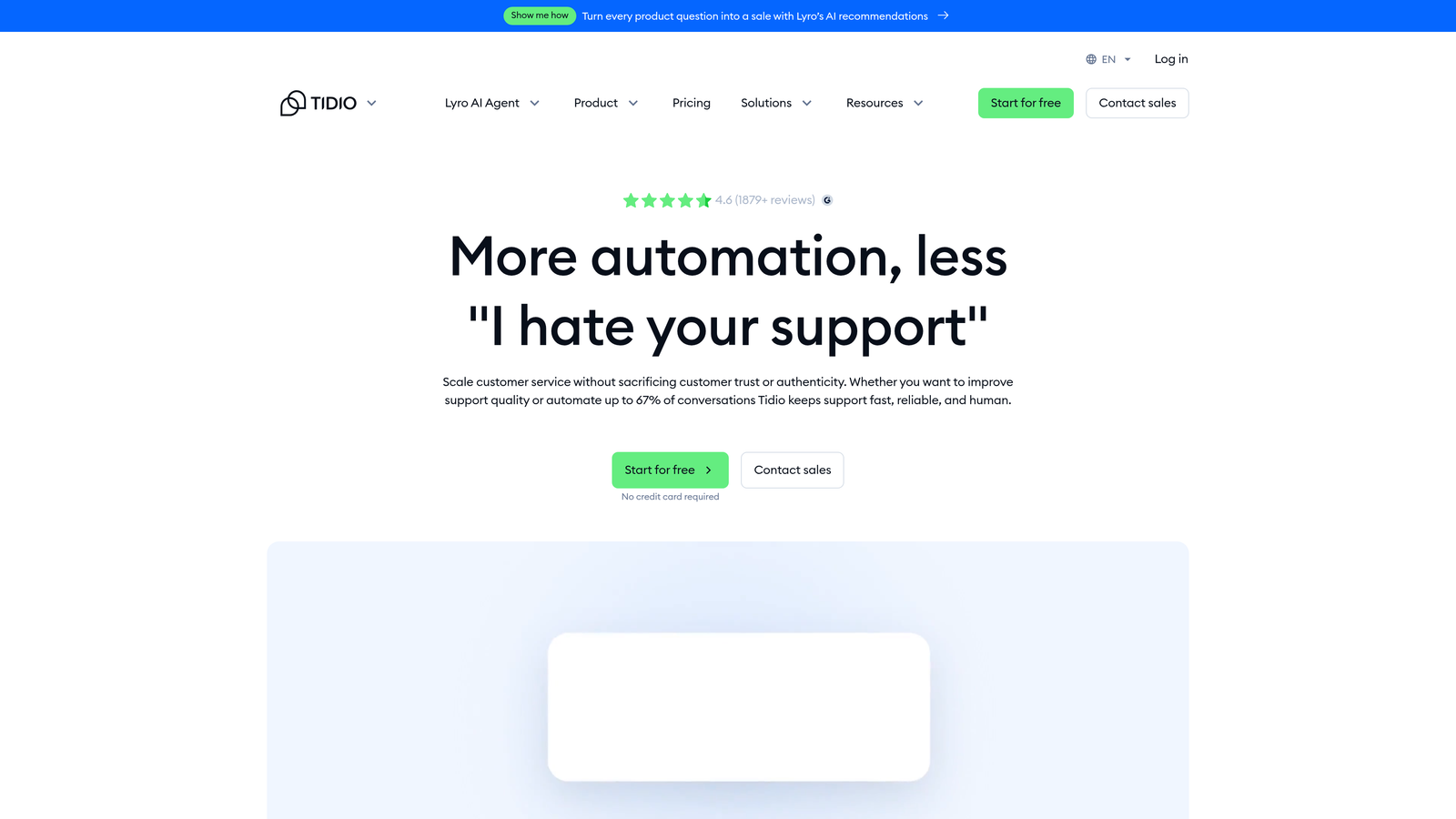
5. Tidio
Best for: Small businesses and e-commerce teams wanting accessible AI support without enterprise complexity
Tidio makes enterprise-grade AI support accessible for smaller teams through its Lyro AI agent, which handles common customer queries with natural conversation and a setup process measured in minutes, not weeks.
Where This Tool Shines
Tidio removes the implementation barrier that keeps many small businesses from adopting AI support. Where enterprise platforms require significant configuration, training, and IT involvement, Lyro can go live quickly using your existing FAQ content and knowledge base. For e-commerce teams fielding repetitive questions about orders, shipping, and returns, that speed to value is significant.
The live chat fallback is a smart design choice. When Lyro reaches the edge of its capability, the conversation transitions to a live agent rather than leaving the customer with an unhelpful response. This keeps the customer experience intact even when AI resolution isn't possible.
Key Features
Lyro AI Agent: Handles common queries autonomously using natural language, trained on your existing support content.
No-Code Setup: Configurable without developer resources, designed to go live quickly for non-technical teams.
E-Commerce Integrations: Native connections to Shopify, WordPress, and major e-commerce platforms for order and product context.
Live Chat Fallback: Smooth handoff to human agents when Lyro can't resolve, preventing dead-end conversations.
Accessible Pricing: Free tier available, with Lyro AI on paid plans at price points designed for smaller teams.
Best For
Tidio is the right choice for small businesses, e-commerce stores, and early-stage startups that need AI support without the cost or complexity of enterprise platforms. Teams requiring deep integrations, business intelligence, or complex escalation logic will outgrow it quickly.
Pricing
Free tier available. Lyro AI is included on paid plans. Verify current pricing at tidio.com.
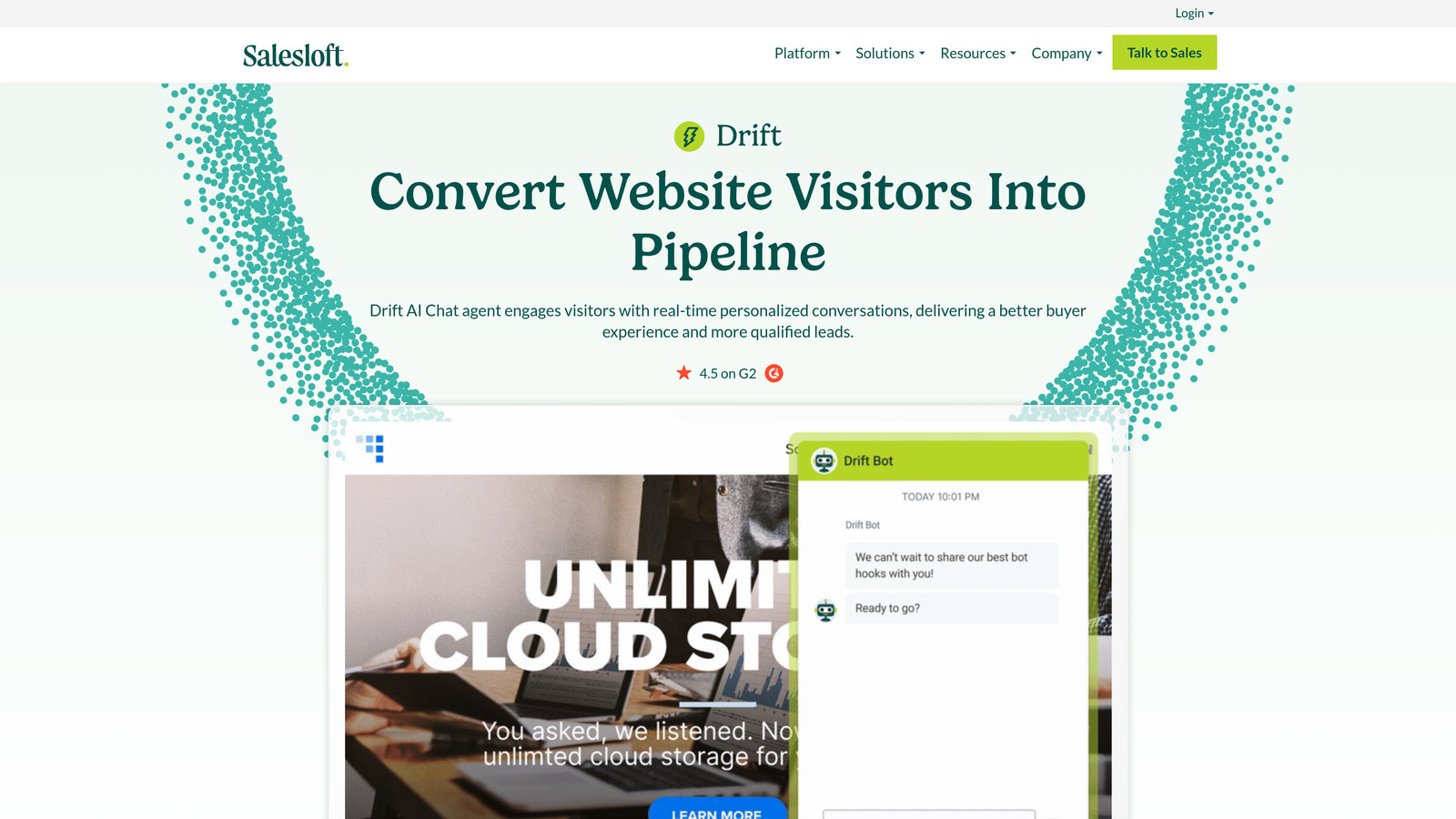
6. Drift (Salesloft)
Best for: B2B teams where support conversations directly connect to pipeline and revenue
Drift, now part of Salesloft, uses AI-powered conversation routing to bridge support and sales interactions, making it a strong fit for B2B teams where a support conversation can just as easily become a renewal or upsell opportunity.
Where This Tool Shines
Drift's differentiation is its revenue lens. While most support tools measure success by ticket deflection and resolution time, Drift is designed to surface buyer intent signals during conversations and connect those signals to pipeline activity. For account-based B2B teams, that means a support interaction can trigger a sales follow-up, a renewal conversation, or a meeting booking without the customer ever leaving the chat.
The integration with the broader Salesloft revenue platform deepens this capability. Support data flows into revenue workflows, giving sales and CS teams a more complete picture of account health and engagement.
Key Features
AI Conversation Routing: Connects support conversations to pipeline data, routing intelligently based on account status and intent signals.
Buyer Intent Signals: Surfaces real-time intent data during support conversations to identify expansion or at-risk accounts.
Meeting Scheduling: Enables direct booking with sales or CS reps from within a support conversation.
Conversation Playbooks: Automated flows for common support and sales scenarios without manual intervention.
Salesloft Integration: Deep connection to the Salesloft revenue platform for unified account intelligence.
Best For
Drift works best for B2B SaaS and enterprise teams where the line between support and sales is intentionally blurred. If your primary goal is pure support resolution efficiency without a revenue angle, other tools on this list will serve you better.
Pricing
Enterprise-focused pricing. Verify current plans at drift.com.
7. Kustomer
Best for: High-volume consumer brands needing deep customer context across every channel
Kustomer is a CRM-native customer service platform that unifies the entire customer timeline, orders, interactions, and history, with AI-powered workflow automation across every support channel.
Where This Tool Shines
Kustomer's defining feature is the unified customer timeline. Rather than treating each support ticket as an isolated event, Kustomer gives agents (and AI) full visibility into everything: past conversations, order history, returns, billing events, and channel interactions. That context makes both AI automation and human responses dramatically more relevant and efficient.
For high-volume consumer brands, this depth of context matters enormously. An AI that knows a customer just received a damaged order for the third time can respond with appropriate urgency and empathy rather than a generic resolution script.
Key Features
Unified Customer Timeline: All interactions, orders, and history consolidated in a single view for agents and AI alike.
AI Workflow Automation: Automates repetitive tasks and routing decisions based on customer data and conversation context.
Omnichannel Coverage: Handles email, chat, social, SMS, and voice from a single platform.
AI Sentiment Analysis: Detects customer sentiment to trigger proactive service actions before issues escalate.
CRM-Native Architecture: Customer data is first-class, not an afterthought, making every interaction context-rich by default.
Best For
Kustomer is ideal for consumer brands managing high ticket volumes across multiple channels where customer history and order context are central to resolution. It's less optimized for B2B SaaS teams that need product-level AI guidance or developer tool integrations.
Pricing
Per-user monthly pricing. Verify current rates at kustomer.com.
8. Forethought
Best for: Enterprise teams wanting AI capabilities without replacing their existing helpdesk
Forethought is an AI middleware platform that adds autonomous resolution, intelligent triage, and agent assist on top of existing helpdesks like Zendesk, Salesforce Service Cloud, and ServiceNow, without requiring a platform migration.
Where This Tool Shines
Forethought solves a real problem for enterprise teams: the cost and risk of platform switching. If your organization has years of data, workflows, and agent training invested in Zendesk or Salesforce, replacing that infrastructure is a significant undertaking. Forethought sits on top of what you already have, adding AI resolution and triage without disrupting existing processes.
The Discover module is particularly valuable for teams that want to use support data more strategically. It surfaces workflow recommendations and insights from historical ticket data, helping teams identify where automation can have the most impact before building it.
Key Features
Solve: Autonomous AI resolution layer that handles incoming queries on top of your existing helpdesk.
Assist: Agent copilot with suggested replies and real-time knowledge retrieval to speed up human resolution.
Triage: Intelligent routing and prioritization to ensure tickets reach the right team faster.
Discover: Insights and workflow recommendations derived from your historical support data.
Helpdesk Compatibility: Works with Zendesk, Salesforce Service Cloud, ServiceNow, and other major platforms without replacing them.
Best For
Forethought is the right choice for enterprise organizations with significant existing helpdesk investments that want to add AI capabilities incrementally. Teams starting fresh or willing to adopt a new platform will find AI-native solutions offer a more cohesive experience.
Pricing
Enterprise pricing model. Verify current options at forethought.ai.
9. Help Scout
Best for: Small and mid-size teams that prioritize relationship quality alongside AI efficiency
Help Scout takes a human-first approach to AI, using AI Summarize, AI Assist, and AI Drafts to reduce agent effort while keeping people firmly in control of the customer relationship.
Where This Tool Shines
Help Scout's philosophy is refreshingly honest: AI should make human support better, not replace it. That translates into AI features that reduce the cognitive load on agents rather than attempting full autonomous resolution. For teams where tone, personalization, and relationship continuity matter, this approach avoids the impersonal quality that can creep into fully automated support.
The clean, minimal interface is a genuine differentiator for smaller teams. Many enterprise platforms carry significant UI complexity that slows onboarding and frustrates agents. Help Scout's design prioritizes clarity, which means agents spend less time navigating the tool and more time actually helping customers.
Key Features
AI Summarize: Generates instant conversation summaries so agents can switch context quickly without re-reading entire threads.
AI Assist: Adjusts tone, drafts replies, and translates messages to help agents communicate more effectively.
AI Drafts: Suggests responses pulled from your knowledge base, giving agents a strong starting point rather than a blank page.
Beacon Chat Widget: Embedded self-service with access to your Docs knowledge base, reducing inbound volume for common questions.
Minimal, Intuitive UI: Designed for small and mid-size teams where fast onboarding and low tool complexity are priorities.
Best For
Help Scout suits startups, SMBs, and teams in industries where the human voice in support is a genuine competitive differentiator. Teams needing autonomous resolution at scale, deep integrations, or enterprise-grade routing will need a more capable platform.
Pricing
Per-user monthly plans. Verify current pricing at helpscout.com.
Which Tool Is Right for Your Team?
The right AI customer service tool depends less on feature lists and more on where your team sits today and where you want to be in 12 months. Here's a quick way to think through the decision.
If you want AI-first architecture with business intelligence: Halo AI is the standout choice. It's built for teams that want support to do more than close tickets, surfacing revenue signals, product insights, and customer health data alongside autonomous resolution. The continuous learning architecture means it compounds in value over time rather than plateauing.
If you're already on an established helpdesk: Zendesk AI, Freddy AI, and Forethought are the natural paths. Zendesk and Freshdesk add AI natively to their platforms; Forethought adds AI on top of whichever helpdesk you're already using without requiring migration.
If you're a small business or e-commerce team: Tidio and Help Scout offer the most accessible entry points. Tidio prioritizes fast setup and e-commerce integrations; Help Scout prioritizes relationship quality and a clean agent experience.
If support and revenue are intentionally connected: Drift is built for B2B teams where a support conversation can become a pipeline signal. Kustomer serves consumer brands where deep order and interaction history is central to both AI and human resolution quality.
The broader principle worth keeping in mind: AI customer service best practices in 2026 center on context-awareness, smart escalation, continuous learning, and using support data to inform decisions beyond the helpdesk. Not every tool on this list delivers all four equally. Choose the one that matches your current constraints and your growth trajectory.
Your support team shouldn't scale linearly with your customer base. Let AI agents handle routine tickets, guide users through your product, and surface business intelligence while your team focuses on complex issues that need a human touch. See Halo in action and discover how continuous learning transforms every interaction into smarter, faster support.